Dirt To Turf
Native Plants and Wildlife Gardens is devoted to discussing the value of native plants in our
landscapes, wildlife gardening, ecological restoration, schoolyard habitats, green roofs,
and other means of creating healthy gardens for a healthy planet. (Carole Sevilla Brown)
This past summer, it was with heavy heart I said goodbye to another green space in Toronto – The
Back Campus field at the University of Toronto, where I studied and now work. It was a pastoral
setting amongst heritage buildings and old English elms. It was an integral part of the university
commons.
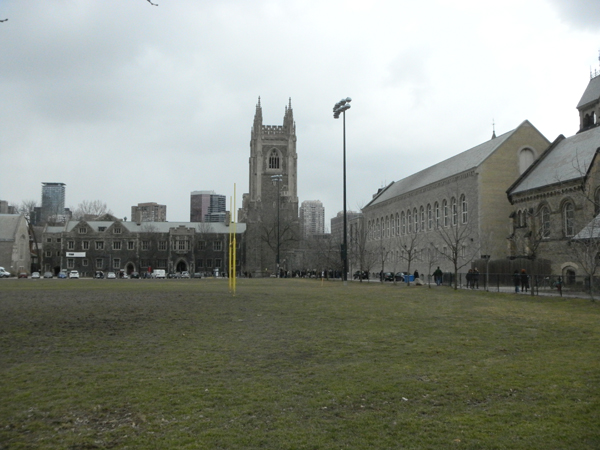
U of T Back Campus field. Soldiers’ Tower in the background.
Previously, during 1992-94, a plan was pursued to have underground parking with an artificial field
on top, but it was ultimately stopped.
Then, the push for the Pan Am Games 2015 led to a proposal to pave and then artificially turf the
historic back campus to build two international field hockey pitches. (Note: there are only 25 field
hockey players currently at the institution).
In a flagrant lack of transparency, an ill-informed Governing Council used in-camera proceedings and
never disclosed its actions until a contract had been signed to proceed with the paving.
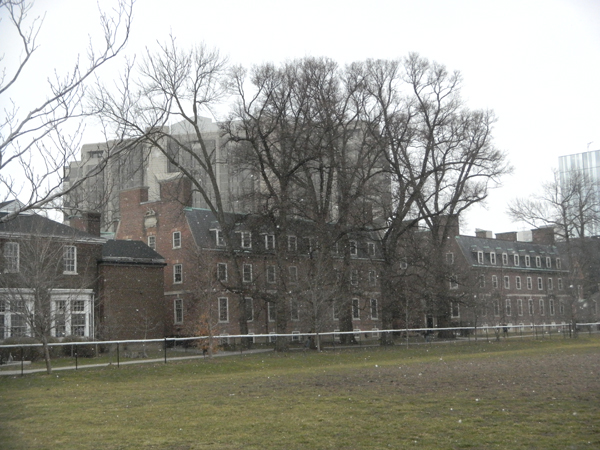
English elms (Ulmus procera) approximately 130 years old were inoculated against Dutch Elm
disease, but would they survive construction activities?
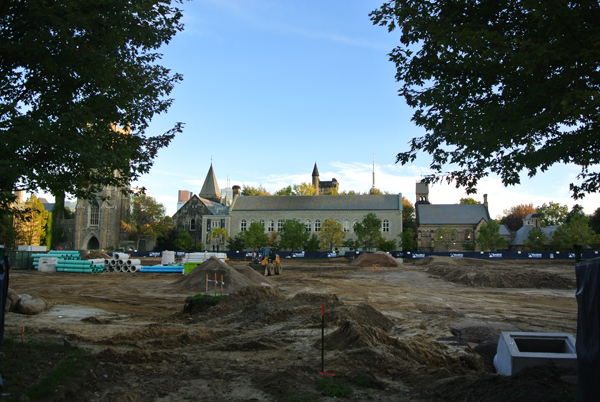
The desecration of a major portion of its campus – to close off a university common and destroy
green space in the heart of Toronto generated a serious backlash which resulted in a last ditch
effort
– a proposal through city council
to designate the green space as a cultural heritage landscape. But to no avail – it was a done deal,
even though an alternative venue was available with the newly constructed pitches in
Brampton, northwest of the city.
Since the Pan Am Games will be hosted in various locations throughout the Greater Toronto Area, it
made perfect sense.
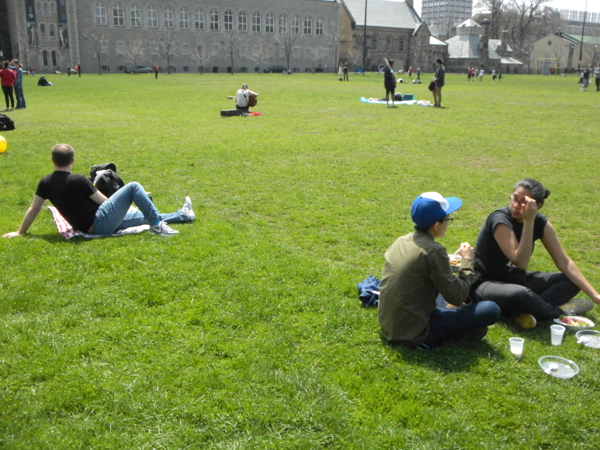
One rally to save the field involved using the field as a playground en masse, just as it has
been for the life of the university. Some students took to playing guitar, blowing bubbles,
throwing Frisbees, or picnicking.
If the field was accused of being in bad shape, it was because it was not maintained well at all.
And to add insult to injury, every winter maintenance personnel used to store snow removed from
nearby roadways. As it melted in the spring tons of garbage would be revealed and included toxic
waste, such as cigarette butts along with oily residues and salt. No wonder the field was never in
good condition.
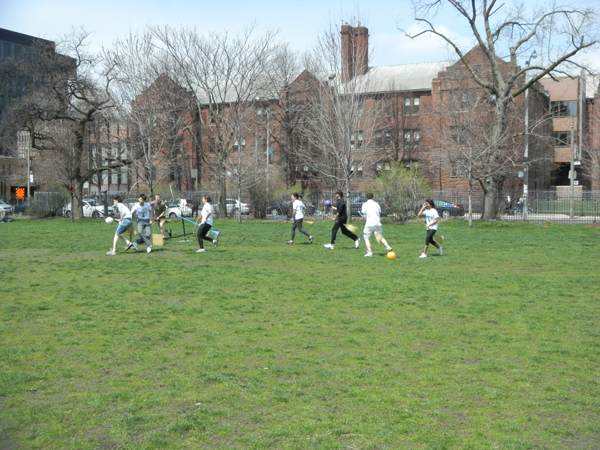
During a rally to save the field, some supporters organized a game of Quidditch, the competitive
sport of wizards in the world of Harry Potter.
Too close to home
So while I was preoccupied with the goings-on at the university campus, two other projects were
flying under the radar near my home.
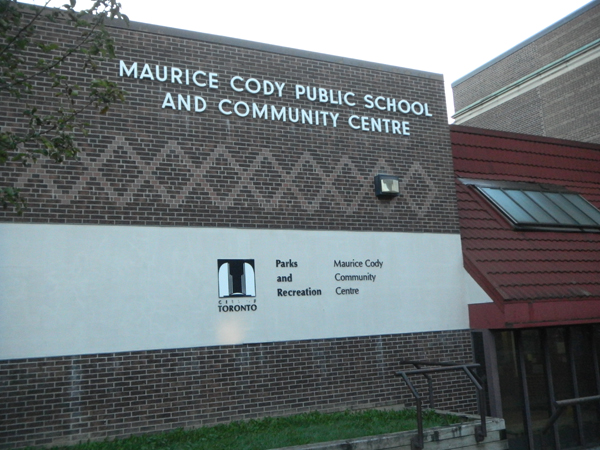
My local primary school and community centre had just undergone a building expansion. They had
converted a small play area that was mulched into a crumb rubber surface with low climbing ropes.
What I hadn’t realized was something far more sinister was afoot – the imminent conversion of
natural turf/mulch to a synthetic field.
Apparently, the local school board (TDSB) gave the parents or a select group of parents two choices
for the surface of their playground: dirt or turf (artificial). They tried once to re-sod the field
and it didn’t survive the foot traffic. Hence, the campaign for “Dirt to Turf” was born. The
community was not consulted extensively. Many, like me did not dream that they were referring to
artificial turf and not natural turf.
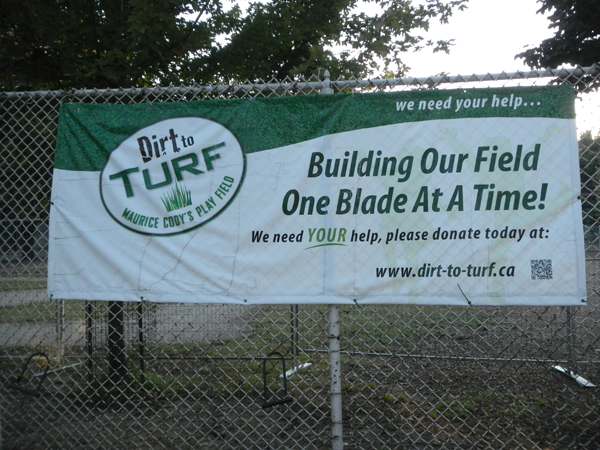
Propaganda (no reference to artificial turf). It should have read: “Building Our Field – One
Plastic Blade At A Time!”
TDSB did not have its own funds to help the project. In fact, TDSB is notorious for selling off
“surplus” school lands to fund their board because they cannot carry a deficit (otherwise the
province steps in and makes cuts to programs). They are letting green space go to condominiums when
they might need it for future expansion in enrolment. Yet, they are squandering on things like
installing pencil sharpeners for $143 a pop!
The major funding was secured through
Section 37
monies, a community development fund fed by concessions given to developers seeking additional
amenities in contradiction of the planning department’s mandate. As well, some parents and local
businesses raised funds.
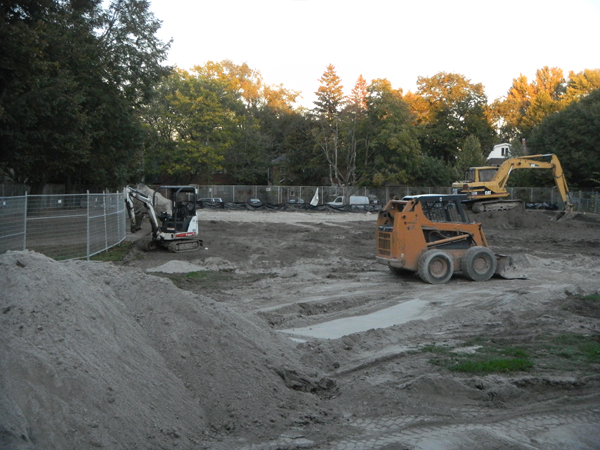
In the throes of construction at Maurice Cody.
An elaborate pamphlet showed up in my mailbox with
before and after
pictures of the field with fundraising sponsorship levels and a
diagram and description of the design.
The “after” picture showed artificial turf surrounding tree trunks, but the diagram revealed a
fairly generous mulching area around the trees (little solace to those who wanted to keep it
natural).
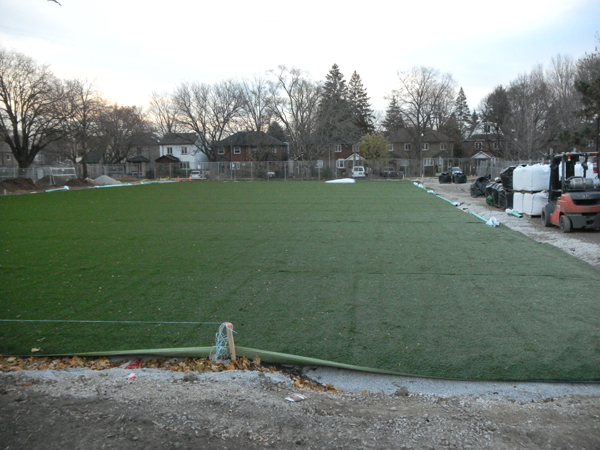
Almost completed installment of plastic carpet. Note the layers of aggregate and filter cloth
along the edge (no crumb rubber infill).
Is there an epidemic of synthetic turf fields on school grounds?
A couple of local highschools have succumbed to the sell-off-land-for-condos scheme and converted to
synthetic fields. Two other primary schools nearby had already been infected by the artificial turf
syndrome: Sunnybrook School, private, and the public Bessborough Drive Elementary and Middle School
in nearby Leaside.
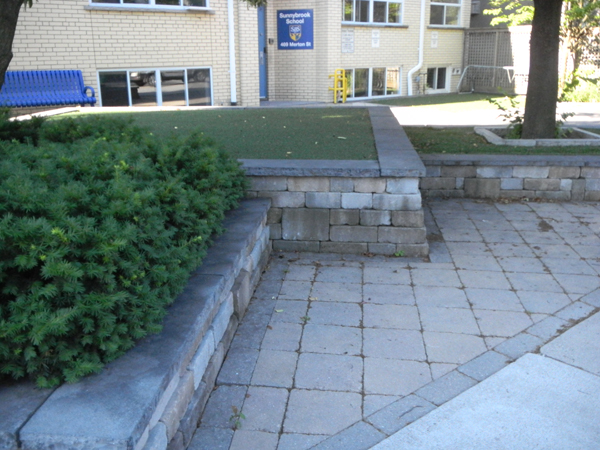
Sunnybrook School. All turf here is artificial. All greenery is tidily contained. Amazingly, the
yew and trees are as natural as they can be given the circumstances.
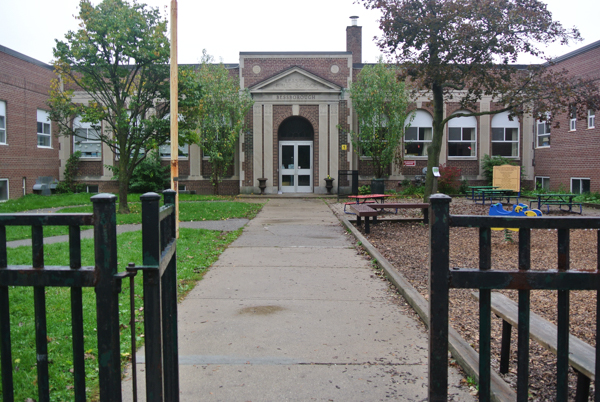
Bessborough Drive Elementary and Middle School. Natural turf to the left; mulch to the right.
Some opt for the front (above), while others like Bessborough School hide it in the back.
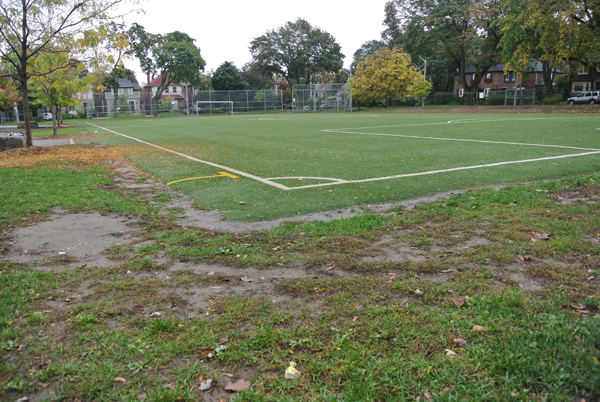
The outback at Bessborough. Where the wild things are? More likely – where natural meets
artificial. Note: the fringe element is not maintained (full of weeds and bare spots).
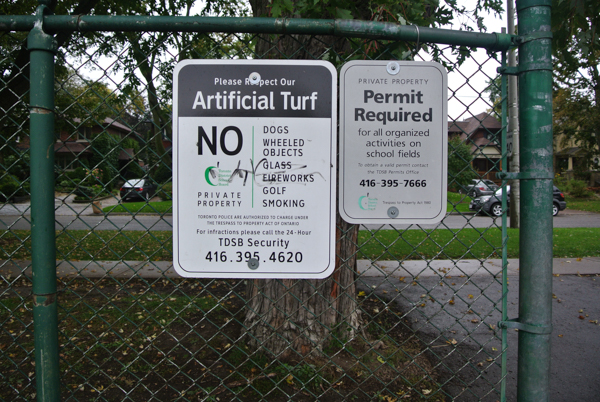
Signage: private property. Since when is public school, private property? Please respect our
artificial turf.
Signage: Private Property! Since when is public school, private property? Please respect our
artificial turf (they didn’t respect the sign…)
Now this is getting down right ridiculous
Two neighbours just north of me shared a contractor to do some backyard work. One installed a large
shed, fire pit and pavers. The other installed a children’s playset.
My immediate neighbour invited me to take a look over their fence to check out the kid’s playground.
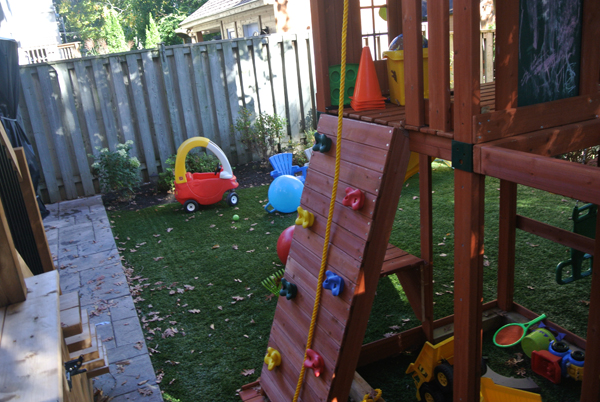
The neighbours. What were they thinking?
Something didn’t look right, so I stuck my hand between the fence slats and confirmed my worse
suspicions – fake lawn! I had never experienced it on a private residential level.
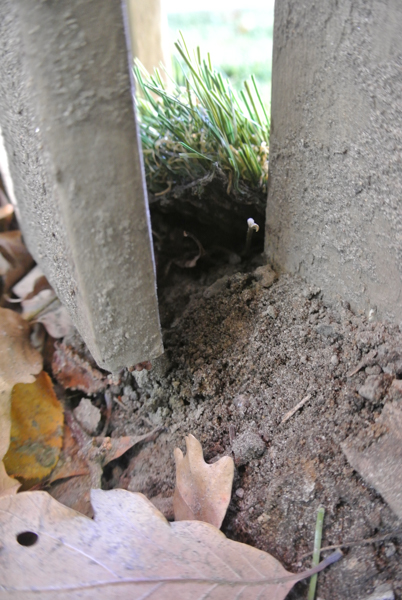
Move along…no backyard habitat here.
There it was barely contained, just on the other side of the fence – artificial turf peaking through
fence. I reached in to and tugged on it, but it was firmly glued down.
The large white oak (Quercus alba) has a commanding presence with a dbh of at least 90 cm (36+”).
I’m not sure how much soil was extracted, tree roots disturbed and aggregate laid on top as a base
during the construction. I would hazard a guess that the plastic turf is glued down right up to the
base of the tree.
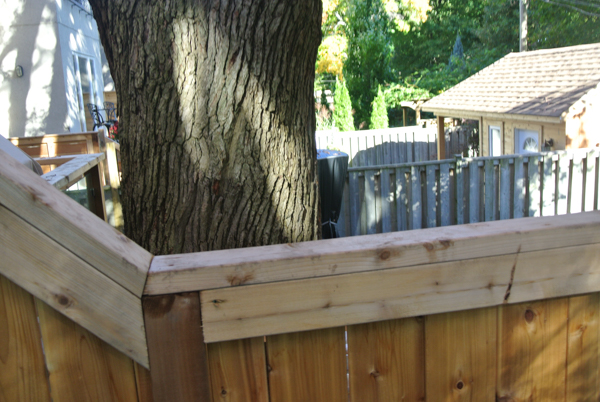
Trunk of white oak (Quercus alba) with large root print in the backyard.
It would be a shame to lose a tree that provides all the ecosystem benefits of a large, mature tree
and native plant: oxygen, shade, air filter, nesting sites and acorns for squirrels, habitat for
invertebrates and thus food for birds.
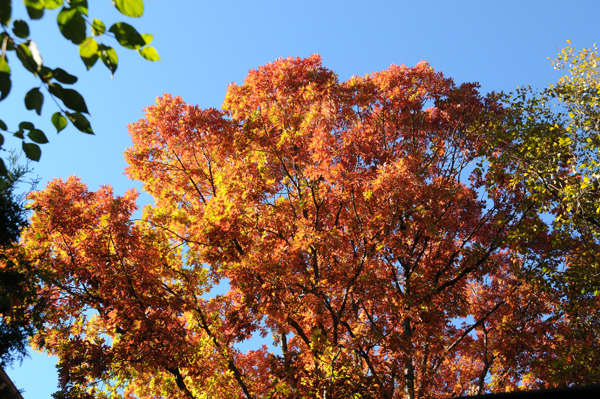
White oak tree (Quercus alba) with canopy aflame in fall. I hope this tree doesn’t get
“burned”.
GREEN IN COLOUR, ONLY!!!
Make no mistake – artificial surfaces are not green spaces. I’ll tell you why:
- by definition, an artificial surface is not natural and does not undertake evapotranspiration (cooling effect) as would a natural system; it is equivalent to pavement
- negative impact on surrounding trees during excavation
- negative heat island effect
- watering and storm sewer runoff with leachate from the petroleum product (synthetic turf) plus any biocides or algaecides to deter bacterial or algal growth or solvents to remove gum, paint, etc.
- increased injuries – the sports fields of public schools are very hard (no rubber crumb layer which while more toxic, allows for softer landings)
- heightened restrictions imposed on the use of the field and the time of use by the community (exclusionary, additional permit fees?)
- unsustainable – short lifespan and replacement of artificial surface within 8-12 yrs. and base in about 20 yrs. (landfill or recycle worn out turf?)
Water Runoff
Aggregate layers allow permeability but…perforated collection pipes connect to existing storm pipes
to capture and accelerate controlled field drainage. Storm water runoff from synthetic turf with its
toxic leachate is transported to the sewer system storm and goes straight to the lake, untreated.
And since antimicrobial treatment is standard practice on artificial turf fields, it also goes
straight to the lake, untreated. In the past, school children have painted yellow fish beside storm
sewer grates to remind residents not to dump anything down the grate or wash their car in the
driveway in such a way that allows effluent to go to the curb and drain into the storm sewer system
(it is a bylaw offence in Toronto to dump anything in the storm drains, unless it is approved
larvicide under the mosquito abatement program of controlling West Nile Virus). Soap, biodegradable
or not, can strip the protective mucous layer from fish. Antimicrobial agents can’t be a good thing
for rivers and streams, either.
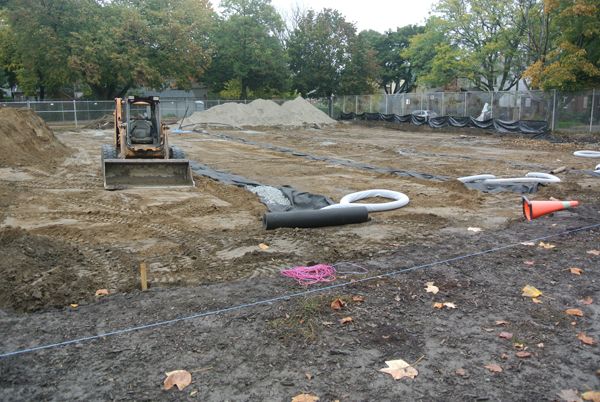
Drainage piping installed at Maurice Cody.
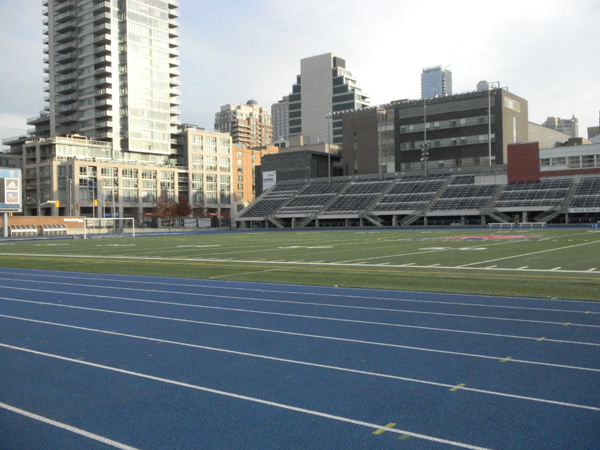
Tiny blue balls of rubber…don’t make me happy when they are blowing around in the environment.
And then there’s the problem of whether toxic compounds from crumb rubber could be released into air
or water. At Varsity Stadium when the synthetic turf layer was being installed, tiny blue balls of
rubber were blowing around all over the sidewalk and settling in the grassy plots of trees, outside
the stadium. If the crumb rubber was made from recycled tires, it would be of variable quality and
variable toxicity being spread about.
Heat Island Effect
The ‘heat island’ refers to urban air and surface temperatures that are higher than those of nearby
rural areas. Built up areas have more paved over surfaces which absorb heat during the day and
release it at night.
These impacts include:
- increased energy consumption (increased demand for cooling = air conditioners)
- elevated emissions of air pollutants and greenhouse gases (climate change buddies)
- compromised human health and comfort by contributing to general discomfort, respiratory difficulties, heat cramps and exhaustion, non-fatal heat stroke, and heat-related mortality. Heat islands can also exacerbate the impact of heat waves
- impaired water quality (heated stormwater generally becomes runoff, which drains into storm sewers and raises water temperatures as it is released into streams, rivers, ponds, and lakes, threatening aquatic life. (According to the US EPA)
One way to identify hot spots is by taking a snapshot of infrared radiation or the heat energy
emitted from a material.
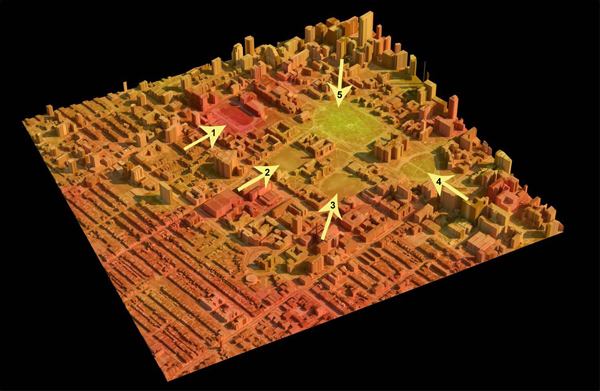
Infrared pic of the area around the University Campus. Note the difference between the
artificial (1) and natural fields (2-5), with the artificial site showing up as a hot spot on
infrared photography. (Original photo: John Danahy)
Key:
(1) U of T, Varsity Stadium (former site also hosted concerts, including the infamous John Lennon &
Plastic Ono Band on September 13, 1969)
(2) U of T, Back Campus (now under conversion to an artificial field). My workplace is beneath Arrow
2.
(3) U of T, King’s College Circle – natural turf; site for intramural sports and pathway for the
graduate migration across to Convocation Hall to receive their degrees.
(4) Front lawn of the Ontario Legislative Building
(5) Queen’s Park (arboretum and squirrel sanctuary)
“The worst offender for heat island effects in the downtown area of the campus was the conversion of Varsity stadium to artificial turf and the track . . . There is a direct correlation with the urban surfaces that are living and cooling effects during heat events. Evapo-transpiration cools the surfaces and mitigates urban heat island effect.
Not enough people on campus have considered the impact of artificial turf on heat impacts . . . We were shocked when we made the first image and then traced the change to the dates of construction. Who would have thought that nice “green looking” varsity open space would be the hottest area?
(Referring to Back Campus conversion to artificial surface). There seems to be no reference in the proposal to an assessment of the heat impacts of converting such a large surface area from a living surface to an artificial surface. If this were a building it would be required to have a green roof and a parking lot would be required to compensate with tree canopy as I understand they were asked to do with the parking lots for the Pan Am Scarborough site as part of the Toronto Green Standards.” ( John Danahy, Centre for Landscape Research in the Faculty of Architecture, Landscape, and Design).
Stuart Gaffin, an associate research scientist at the Center for Climate Systems Research at
Columbia University, initially became involved with the temperature issues of synthetic turf fields
while conducting studies for another project on the cooling benefits of urban trees and parks. Using
thermal satellite images and geographic information systems, Gaffin noticed that a number of the
hottest spots in the city turned out to be synthetic turf fields. He measured
the temperatures of different surfaces to illustrate the point:
air/water = 94 F (34.4C); Bermuda grass = 104 F (40C); sand = 132 F (55.6C); asphalt = 136 F
(57.8C); synthetic turf = 165 F (73.9C).
How do they propose to mitigate of Heat Island Effects?
There isn’t much you can do if you go the route of synthetic. The only thing you can do is irrigate,
including wetting down the surface area when it’s hot. The irrigation requirement for elite sports
turf is higher than that for premier or local sports turf (typical schoolyard). And then you have
that pesky problem of storm sewer runoff with leachates.
For natural turf, depending on location, the irrigation requirement for cool season
grasses is higher than that for warm season grasses.
Meanwhile….
Field of Dreams – Professional sports returns to grass
A few articles have appeared in the local papers about pro sports returning to their roots…as in
natural grass roots. BMO soccer field converted back to natural. Skydome (now Rogers Centre) is
looking to replace their artificial turf with grass for the local baseball team, Toronto Blue Jays
by 2018.
If pro sports are heading back to natural turf and amateur sports (highschool, primary school) are
heading in the opposite direction, then schools should be side-lined until they come to their
senses. This is the antithesis of what a schoolyard should be. They should be more involved with
“greening” schoolyards, e.g.,
School Habitat Garden in Illinois Prairie Country.
“Installing natural grass instead of artificial turf can save the school in excess of $1,460,000 over 20 years, money that could be spent on other projects or programs.” Source: The Truth about Artificial Turf
Links to articles
Monsanto chemists invented
AstroTurf in 1964 and
initially called it “chemgrass”. Its original purpose was to replace natural grass that had
difficulty growing in indoor stadiums. The Houston Astrodome was the world’s first fully enclosed
stadium with a synthetic turf field. Synthetic turf was designed for both portable and permanent use
either indoors or outdoors. Base construction can be concrete, crushed stone, infill layers of crumb
rubber, or asphalt.
A good synopsis on the history of turf –
Synthetic Turf: Health Debate Takes Root.
The Truth about Artificial Turf – pros and cons of natural vs artificial turf.
The ongoing deconstruction of the natural field to synthetic at
Back Campus field, U of T.
Keeping Back Campus Green Facebook page
devoted to keeping the Back Campus Green and now to holding the memory of restoring it after 2023,
when the item is revisited at City Council.
Alarm raised about
Toronto looking like a set from Teletubbies.
When community residents were
promised field access, but then there were the permit fees.
Originally published December 26, 2013 on Native Plants and Wildlife Gardens
Comments

Rae says
November 27, 2013 at 8:32 am
November 27, 2013 at 8:32 am
Thanks for the thorough article. I feel your pain. Have seen a lot of backward things, but frankly
have not seen synthetic turf here. At a time when we like to think that the green/ecological
awareness is growing, it is really surprising that this seems to be a trend there. Education helps,
and you are doing a good job of that.
Reply

Janet Harrison says
December 7, 2013 at 11:06am
December 7, 2013 at 11:06am
Thanks so much, Rae. It is a difficult to get the word out about the pitfalls of synthetic turf
when all people can see is a quick fix to their problem of a muddy yard or patches of grass not
growing under a Norway maple. To them, appearance and convenience is everything. The fact that
it is not sustainable and even detrimental is way down on the priority list. If you must have
lawn, say for schoolyards, it takes more planning and more maintenance to keep grass under such
difficult conditions. For other situations, we advocate for alternative groundcovers that add
worth by sustaining wildlife, i.e., native species groundcovers.

John Oyston says
November 27, 2013 at 11:27 am
November 27, 2013 at 11:27 am
Great article Janet, thanks for all the research. The North American Native Plant Society is
spreading the word on our Twitter account and on our Facebook page,
Reply
Janet Harrison says
December 7, 2013 at 11:14 am
December 7, 2013 at 11:14 am
Thanks, John. I appreciate you spreading the word. There is so much more to research and I’ve
added it to my to-do list to document losses of green space, particularly the conversion of
playing fields within Toronto from natural to artificial turf. We always joke about lawn being
“green concrete” because as a groundcover it acts more like a hardscape. One step further would
be to call synthetic turf “green asphalt”, especially given its origin as a petroleum product,
heat island effect and residues as it degrades over time.

Tony McGuigan says
November 27, 2013 at 1:22 pm
November 27, 2013 at 1:22 pm
Janet,
Sorry to you got to so slowly witness habitat loss right under your work window — must have been hard!
Sorry to you got to so slowly witness habitat loss right under your work window — must have been hard!
Nice post. Very thorough, as usual. Like the in-process construction pics, and the “history now”
pics of the lawn being used by humans for social outlet.
Plastic turf — what where they thinking?! (or NOT!)
Tony
Tony
Tony McGuigan recently posted.
A School Habitat Garden on the Prairie
Reply
Janet Harrison says
December 7, 2013 at 11:26 am
December 7, 2013 at 11:26 am
Thanks, Tony. I walk by the construction twice a day on my work commute. Fortunately, my
building is under the stem of the arrow and not under the arrow head, so I’m not witness to the
destruction on a minute by minute basis. They are still digging and moving aggregate around. It
will be some time before the top is rolled out and the new field is finished. It will be
interesting as a pedestrian walking by in summer to see if heat emanates to the same extent as
Varsity Stadium. I pass by the stadium twice a day and in the summer you can really feel the
heat blasting. It was uncomfortable and I didn’t hang around to get cooked.

Marilyn says
November 27, 2013 at 5:25 pm
November 27, 2013 at 5:25 pm
Here’s what the CDC has to say about artificial turf and health issues.
Artificial Turf.
Reply
Janet Harrison says
December 7, 2013 at 11:58 am
December 7, 2013 at 11:58 am
Thanks for the link, Marilyn. I will be investigating the type of material used in the turf by
the school board. I’m not sure if they stuck with polyethylene (less lead content) or a blend
with nylon fibres (much higher lead levels on degradation).
A very interesting development occurred while I was compiling my research – one of six fields
that Toronto District School Board (TDSB) is viewing to convert to synthetic was discovered to
have high levels of heavy metal contaminants like lead, zinc and other various chemical
compounds. So, the project at that school, Central Tech highschool has been put on hold for the
time being. (Central Tech field closed to determine whether soil is contaminated)

Carole says
November 27, 2013 at 6:36 pm
November 27, 2013 at 6:36 pm
Disheartening! :(
Reply
Janet Harrison says
December 7, 2013 at 12:00 pm
December 7, 2013 at 12:00 pm
You said it, Carole. So wrong on so many levels. It’s hard not to feel it’s one big experiment
and we are the guinea pigs in a long term study.

Dee says
November 30, 2013 at 3:22 pm
November 30, 2013 at 3:22 pm
You did a fantastic job on this article! It’s so thoroughly researched & informative. The heat
surface photo is an eye opener, proof this plastic lawn is very damaging to the environment.
The people putting this in their back yards have gone way to far & are putting their children’s
health at risk. It’s like having their children play on poison.
As for the schools, it’s a shame this is happening & the children are being exposed to these noxious
chemicals. They’re bound to have health problems later on in life, that will be directly related to
their exposure to the turf.
Reply
Janet Harrison says
December 7, 2013 at 12:22 pm
December 7, 2013 at 12:22 pm
Thank you, Dee. The more we question, speak out and educate, the better we can make informed
decisions. I resent having my taxes pay for tearing out green space in the public realm. I would
rather have more school yard revitalization along the lines of natural playfields.
I attended a meeting this week about revitalizing a portion of Toronto Waterfront which will
involve depaving a former parking lot and installing natural landscape, hopefully all native
species. There will be opportunities for all to enjoy this new green space. This morning, I bore
witness to the ribbon cutting at the new Maurice Cody PS artificial field. What a contrast! A
room full of environmentally-savy, diverse, informed citizens versus a small group of
ill-informed, single-minded, sports parents and their children. (It is just an observation based
on first hand experience; I am not trying to sound elitist or be offensive).

Loret says
December 1, 2013 at 4:55 pm
December 1, 2013 at 4:55 pm
That infrared photo is mind boggling. What are they THINKING????? Great reporting, Janet
Loret recently posted.
The tussock
Reply
Janet Harrison says
December 7, 2013 at 12:29 pm
December 7, 2013 at 12:29 pm
Thanks, Loret. I was surprised to learn synthetic field with crumb rubber infill is much hotter
than asphalt, even though it is not black which is usually more conducive to absorbing heat. I
presume the lower cost synthetic field used at the primary schools will have surface summer
temperatures that fall somewhere between asphalt and the higher end sythetic turf fields. Still,
it will be hotter than any vegetation, mulch or bare soil. Such a shame!

Green Bean says
December 2, 2013 at 1:03 pm
December 2, 2013 at 1:03 pm
A few years ago, over the objections of the community, our city put turf in on a large sports field.
That field is now only used for sports. No biking, no picnicking, no dog walking. This past year,
they city tried to put in artificial turf in another park. Folks around here have wised up though
and know that artificial turf = dead zone. We fought it and we won! Thank you for this post. We need
to educate, educate, educate!
Reply
Janet Harrison says
December 7, 2013 at 12:51 pm
December 7, 2013 at 12:51 pm
Green Bean, I’m sorry you lost a very public green space. It is very tragic for the community as
a whole. But, congratulations on defeating the second imminent threat. Unfortunately, sometimes
it takes a loss to spur on a bigger groundswell of activism. We must always be informed and
vigilant.
My councillor who has been sucking heavily for some time on synthetic turf fumes via Section 37
funding of TDSB fields told me he wouldn’t consider artificial turf for the revitalization of
our local park, Davisville (aka June Rowlands Park). I will hold him to that. Our parks are
under the auspices of the city’s Forestry, Parks and Recreation and are not adverse to synthetic
fields. Several have been converted. I can only hope the more trees spread across a park, the
less risk of a wide open field for sports and an unnatural conversion.
Trackbacks
Dirt to Turf | Planting & Landscape Design ... says:
November 28, 2013 at 8:06 am
November 28, 2013 at 8:06 am
[…] Native Plants and Wildlife Gardens is devoted to discussing the value of native plants in our landscapes, wildlife gardening, ecological restoration, schoolyard habitats, green roofs, and other means of creating healthy gardens for a healthy planet. […]
Dirt to Turf | Planting & Landscape Design ... says:
November 29, 2013 at 8:05 am
November 29, 2013 at 8:05 am
[…] A very disturbing trend has emerged in Toronto with the installation of artificial turf at teaching institutions and even at the residential yard level and with the subsequent loss of green space. […]
Native Plant Species Articles Index
The Following articles were originally published on the Native Plants and Wildlife Gardens website.