City Living – Wildlife or Vermin
Wildlife (definition): Wild animals and vegetation, especially animals living in a natural, undomesticated state.
Most think only of animals as wildlife. I wanted to make a point that “wildlife” is not just animals. It includes plants, too. It encompasses all living organisms apart from humans and other domesticated species.
Biodiversity in the City
Well, it is spring and more people are on the move outdoors which usually means more encounters with wildlife, both positive and negative. I had been thinking of urban wildlife lately, given a recent occurrence in which a coyote was shot by Toronto Police and an opinion piece which was published in the local paper: “Time to cull city’s nasty raccoons” – all on the eve of the Biodiversity in the City workshop that I will be attending in two days time.
The workshop is being put on by ICLEI – Local Governments for Sustainability. They are developing a guidebook for Canadian communities on biodiversity management, and are looking to the active community of local practitioners, municipal staff, and conservation authorities to help answer these questions:
What is urban biodiversity?
Why should we protect biodiversity in urban areas?
What is urban biodiversity?
How can municipalities manage urban biodiversity?
I expect the workshop will have a pro-wildlife stance, but it’s difficult to predict with some government officials. Toronto Wildlife Centre, Toronto Animal Services and Toronto Region and Conservation are certainly pro-wildlife. I’m not sure if other departments will be involved like Municipal Licencing and Standards (MLS). Most bylaws are not wildlife-friendly, as evidenced by the many anti-vegetative provisions in bylaws, including the Grass and Weeds bylaw and the Property Standards bylaw that I discussed briefly in previous posts: A tale of two city yards and Living on the Edge – Boulevard of Broken Dreams.
I hope we get a mix of interested parties including those who feel wildlife, particularly wild animals, have no place in the city. Indeed, the comments about the coyote shooting were split very sharply between pro-wildlife and anti-wildlife. Comments included “wildlife doesn’t belong in the city” and “the last time I looked the people of Toronto were paying the taxes for the right to live in this city and not wild animals.” When I hear comments such as these, I shudder and fear that the attitude is so hostile that wildlife would be unacceptable anywhere. Carole Sevilla Brown addressed similar concerns in a post: Helping Your Neighbors Learn to Love Wildlife It is an ongoing struggle to educate people and rally for wildlife.
And then there’s the other faction: the “they were here first” camp. Wildlife pre-dated the appearance of humans so they should have more right to stay. I don’t like to get into this type of argument. It’s all very well to try to put all Nature first; all life together as equals or having an equal stake in the planet. But the reality is humans are calling the shots. They-were-here-first argument does not have credence most of the time even among humans. A neighbour who is established does not have more rights than a new neighbour. They both are equal in the eyes of the law, unless there is a “grandfathering” of a bylaw, for instance. The first-here argument does not get us anywhere. (Let’s not even go near the argument of first-here with native vs exotic, either).
It reveals quite a dichotomy in opinion and the level of fear and ignorance which we encounter. And as we know, fear comes largely from ignorance. Again, education is the solution.
The City and Wildlife
Wildlife is never far from my mind. I’m trying to maintain a welcoming oasis amidst a desert of conventional yards, much of which has little wildlife in the form of plants or animals (or other organisms). Yet, wildlife will move through looking for food and shelter and mates, regardless of the type of garden, whether immaculate lawn with clipped shrubbery or a wild, native paradise. Wildlife is living amongst us and we have to deal with it.
As the human population increases, incidents of human-wildlife encounters will also increase. Right now, my city, Toronto, ranks as being the fourth largest city in North America, that is, in human population (just shy of 2.8 million). A press release bragged about surpassing Chicago as the fourth most populous city after Mexico City (8.9 million), New York (8.2 million) and Los Angeles (3.8 million).
A large human population is not something to brag about. It comes at a cost to our planet. What will that do to our wildlife? Are we welcoming or accepting? Or is the welcome mat only reserved for people? Are we pushing out wildlife inadvertently or even deliberately? These are only some of the questions arising and I feel mixed messages are being given out by government sources.
There’s more…
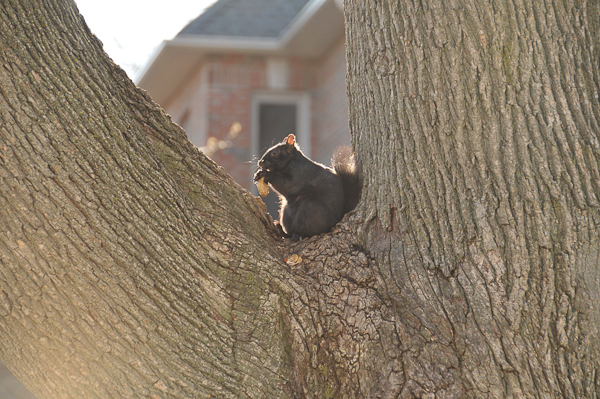
Melanistic eastern gray squirrel (Sciurus carolinensis) feeding on a handout.
Wildlife Gardens – are we creating a problem?
Are we concerned that by creating wildlife gardens, we are attracting some species that we are hesitant in inviting to stay, like raccoons, skunks, foxes, coyotes? Are we reluctant to have medium-sized carnivores roaming our streets? By planting shrubs, having woodpiles, etc., are we encouraging wildlife to set up homes in our gardens thereby allowing them to get more comfortable before they try to invade our homes, garages, sheds, decks, and balconies?
If you feed birds, the seeds can attract mice and rats (“vermin”). It can also encourage squirrels which foxes and coyotes prey on. But the activity also attracts raptors much to the horror of some gardeners with bird feeders. If you have wood piles are you attracting termites or carpenter ants which can damage wooden structures?
All of these concerns need to be addressed at some point.
Bylaws
This is always a good place to start; to get an idea or some direction. However, bylaws are typically vague and bereft of definitions that would be helpful for the gardener. My local bylaw
The Property Standards Bylaw, Toronto Municipal Code Chapter 629 is no exception.
§ 629-9. Pest control.
All properties shall at all times be kept free of rodents, vermin, insects and other pests and from conditions which may encourage infestation by pests.
§ 629-22. Garbage and debris storage and disposal.
D. The receptacles shall be containers that are water-tight, equipped with a tight-fitting cover, rodent- and pest-proof, and shall be maintained in a clean state.
G. The place for temporary storage and disposal of garbage and refuse shall be kept in a litter-free and odour-free condition, maintained in a manner that will not attract pests, create a health or other hazard, or obstruct an emergency route, recreation facility, parking area, driveway or walkway.
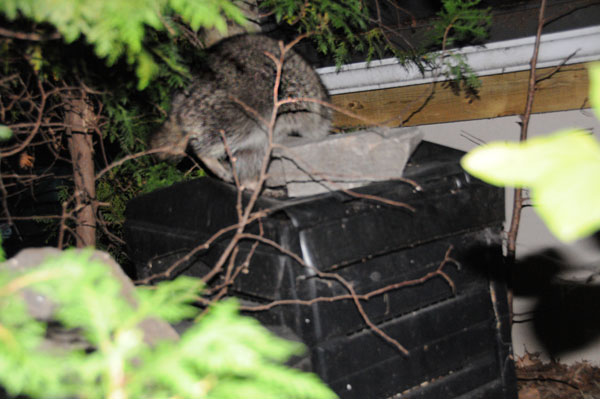
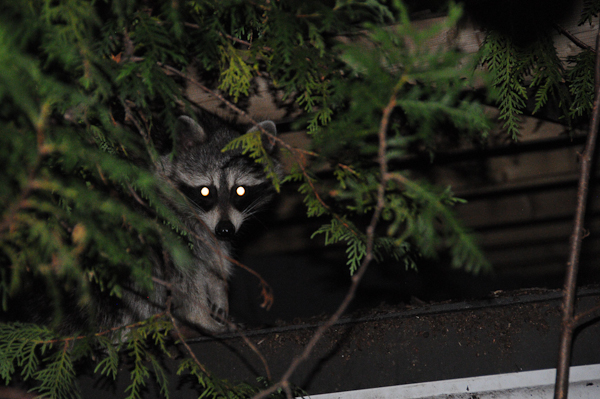
A young raccoon (Procyon lotor) attempts to breach the secure composter.
As a biologist, I take exception to the lack of definitions and some of the terminology. “Free of rodents” – does that include native species: ground and tree squirrels, beaver, muskrat, mice, and voles; all of which are found within city limits? Depending on your location and on the species, native rodents may be a regular, infrequent or non-existent visitor to your property.
Vermin! What does that conjure up? Back to the dictionary to make sure I get the definition straight. “Pest” is a synonym. After checking several sources, they all agree on three things:
Vermin:
1. Small, common, harmful animals, e.g., rats, cockroaches, lice, fleas
2. Animals that prey on game, such as foxes, weasels or coyotes
3. A person considered loathsome or highly offensive
I think we can all agree that “infestations” are not a healthy situation. Animals that compete directly for resources which humans covet (“game”) are included. I don’t think this has bearing in urban areas since there is no hunting or trapping allowed within city limits (unless an agency is authorized to remove animals). I’m not sure if skunks and raccoons are considered vermin. Certainly, homeowners who have their refuse invaded or who have their beloved lawns ripped up by wildlife intent on scoring juicy beetle larvae would consider them pests. Unfortunately, I doubt the bylaws will help with No. 3.
Other issues with the bylaw: All insects are being lumped in with pests. Clearly the bylaw is out of date and does not reflect the fact that insects and other organisms are a necessary part of an ecosystem, including the urban environment. The bylaw needs a revamp if we are to appear to be a wildlife-friendly city.
Are urban animals just part of the city fabric to be treasured or are they a nuisance that needs to be exterminated?
This is one example of mixed messages. A negative association with wild plants, or “weeds” pops up in several bylaws. Yet, wild animals are another matter: The City of Toronto endorses wildlife (animals) and suggests that we have to learn to live in harmony.
The emphasis is on protecting your home:
“We share the city with a wide variety of animals that have adapted to our urban environment. Find out how you can protect your property and live in harmony with the city’s wildlife.”
With respect to home invaders (note: animals only):
“We will always have wildlife within our city environment, and we will have problems with these animals until we take preventative measures to reduce their populations by making sure they can’t live in our homes.” Well, at least they are not in denial and recognize that we inhabit our city with non-human residents. That is a start. They do give some good information about wildlife-proofing your home, and deterrents such as a prevention skirt or barrier to prevent wildlife from digging dens under a house, deck, shed, or garage. In other regards, they are off base.
The statement given does not make sense as the problem is not a housing issue for wildlife, but readily accessible food from sloppy garbage practices, improper compost maintenance, and pet food left available for opportunistic wildlife.
(Pet owners – do you really want your pet to eat from the same bowl as a fox, raccoon, skunk or coyote given that saliva exchange could lead to the spread of pathogens?)
Also, the recommendation to use naphthalene or moth balls/flakes to discourage invasion is not something that I would endorse. Moth balls are toxic and we don’t need another poison in the garden; a threat to the environment.
The city discourages the keeping of wood piles, probably to prevent termite and carpenter ant colonies. But it is counter to our mission to create habitat for various organisms such as invertebrates, toads, salamanders, etc., as mentioned in Christy Peterson’s post: Kids in the Wildlife Garden—In Praise of Underneath and for overwintering wildlife like butterfly adults: Mourning Cloak, Question Mark, and Eastern Comma mentioned in Pat Sutton’s post: Butterfly House.
We can’t be neat freaks and expect wildlife to thrive, as some of our other team members have pointed out – Tony McGuigan in Not-So-Clean Up Garden and Vincent Vizachero in Cleanliness in a Wildlife Garden: Bad Idea.
Certainly foraging woodpeckers (sapsuckers, etc.) could deal with wandering carpenter ants. And if the foundation of any wooden structure is not in direct contact with soil, termites cannot go about their normal business.
All it takes is a little common sense, some knowledge about potentially, destructive activities of animals and how to do damage control.
The bottom line
We will have to learn how to live with wildlife as wild organisms will always be with us.
With some precautions, go ahead and create natural food sources but control the easy pickings (compost, garbage, feeders, pets).
If we have an over population of “nuisance” animals, we have to stop feeding them and control our waste practices better.
If you have concerns, suggestions or comments, I’d love to pass them along at the workshop, even if you don’t live in the Toronto area. I will be reporting back next month on what transpired, and discuss any information that can help us live with wildlife. I’ll also take a closer look at some of species that draw the most ire from urban residents and offer some solutions.
Originally published March 26, 2013 on Native Plants and Wildlife Gardens
Comments

Hal Mann says
March 26, 2013 at 10:45 am
March 26, 2013 at 10:45 am
Thank you Janet. You always have such good thought-provoking and sensible comments. I’m anxious to hear the outcome from the workshop.
Hal Mann recently posted..In Search of Spring
Reply

Janet Harrison says
March 28, 2013 at 12:18 am
March 28, 2013 at 12:18 am
Thank you, Hal. I sometimes struggle between the clinical observation from training and the emotional love for wildlife that must be balanced to get the message out. It’s always good to try to stay objective and not shoot from the lip. I took a look at the agenda for the workshop that wasn’t received until after my posting. I suspect much of the workshop will focus on public initiatives – how to adapt to or “incorporate” or manage wildlife in the bigger realm; the public realm of ravines, belt lines, parkland, etc. At this stage, after working with government and now being in the public arena more as a citizen than a gov. participant, I’m more interested in the “end product”, i.e., individual, private ownership lands – our little city plots either individually or collectively held as a community. I really hope that I’m not in the minority, but if so, I will just have to be more thought provoking or different to stand out. However it turns out, the experience will be worth it. ~ Cheers!
Jason says
March 26, 2013 at 12:38 pm
March 26, 2013 at 12:38 pm
I have a strong interest in this subject, especially after having a colony of skunks living under my porch. I do garden for wildlife, but I am not opposed to sensible wildlife controls, either. Right now we seem to be having a population boom for some wildlife in our area – particularly rabbits and skunks. I am confident that the handful of wildlife gardens make very little contribution to this boom – these animals are well-adapted to a human environment without any special provisions from wildlife gardeners.
Also, it is disappointing that there is so much animus against coyotes. I sympathize with people who have small pets, but if we keep out the coyotes we will just have more mice, rabbits, etc. Far more damage is done by the deer population, who pretty much wipe out native vegetation in many nature preserves, parks, etc. Yet there is opposition to controlling the deer population which verges on the hysterical.
Reply
Janet Harrison says
March 28, 2013 at 12:59 am
March 28, 2013 at 12:59 am
Jason, you make some really good points about living intimately with wildlife. I will be delving into this subject more in my next post.
Skunks are a special case. They are a mustelid that can spray. So not only do they exude an odour at all times, they can concentrate a foul, defensive stream at will and with accuracy when encountered. Unfortunately, when they inhabit an area close to your living quarters, you have the constant reminder of their presence and the potential for escalation. Few people will live with this arrangement, particularly if they have a dog. The best recourse is to make your porch, steps or deck impenetrable to digging a den. You may still have them shuffling through your yard looking for food. It helps to get rid of as much lawn as possible which harbours the non-native, white grubs sought after by raccoons and skunks. As a substitute, deep-rooted fescues don’t seem to attract them. And of course, we push the native plants as a lawn substitute, so skunks (and raccoons) might root around in your mulch for grubs but they don’t stay for long, typically.
Re: coyotes. Yes, they are much maligned. In Toronto we have both coyote and coy-wolf. Again, I will discuss this in greater detail in the next post. They are effective in rodent control but also in controlling the Canada Goose population. We need to keep this top, discrete predator around as a natural control.
We don’t have as big a problem with deer In Ontario as our New England friends. The artifically high population of deer is exasperated by maintaining feeding stations over winter to ensure a steady stream of game for hunters – at least in Ontario. It’s market-driven (that’s business) and it doesn’t give good press if the deer are allowed to starve. So, it’s a vicious cycle.

Lynn says
March 26, 2013 at 4:44 pm
March 26, 2013 at 4:44 pm
I agree with your statements, Janet, and those of the other posters. Humans have in large measure divorced themselves from nature and wildlife. Where I live on Long Island we have opossums, mice and raccoons and I love having them around. I don’t feed them. I do feed birds though and try to garden for the birds. Years ago the neighborhood was woodsy and beautiful. People moving in now take down small houses (to build huge houses which take up most of their land) and most of the trees. This is heartbreaking. I wish they could be educated about the value of trees and other plants, animals, and organisms that together create biodiversity.
Reply
Janet Harrison says
March 28, 2013 at 1:16 am
March 28, 2013 at 1:16 am
Thanks, Lynn. You make a really good point about the size of home in relation to the plot of land. The up-sizing of houses, when they gobble up yard space=potential habitat, does not bode well for our wildlife and wild animals in particular. We lose greenspace and all the requisite benefits, but also, it lessens that buffer space that gives us and wild animals some room to manoeuvre in our everyday life. It’s great to be close with wildlife, but as with our human family, it’s stressful being underfoot without some breathing space.
It is heartbreaking witnessing the loss of greenspace. Many of us get that empty feeling in the pit of our stomach immediately, while others are oblivious in the moment and don’t realize it until much later when wildlife has long gone…

Russ Cohen says
March 27, 2013 at 9:36 pm
March 27, 2013 at 9:36 pm
A recently-published book, Nature Wars, by Jim Sterba, does a good job of covering this issue.
See Jim Sterba's website for more info.
Reply
Janet Harrison says
March 28, 2013 at 1:18 am
March 28, 2013 at 1:18 am
Thank you, Russ! The book looks really interesting. I will have to take a look.
Cheers, J.
Native Plant Species Articles Index
The Following articles were originally published on the Native Plants and Wildlife Gardens website.