My Roadside Garden
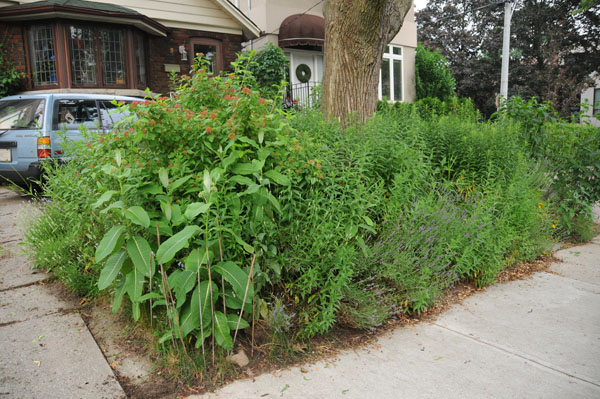
It’s a jungle in there! Full frontal view, Spring 2013.
The North American Aesthetic
What is that? What is a North American garden? It’s not an English garden, European garden or Japanese garden. Although, it doesn’t mean that it can’t look like one of these types, but with the use of native species. I’ve seen cold-hardy, honey locust pruned to look like acacia trees in the African Savannah of the Toronto Zoo.
But seriously, what is a North American garden? Can we achieve it? Why not? We can install it because the native plants are here, although most are not in commercial production, yet. So, we need the native plant nurseries and our own propagation methods to get plants.
I, like NPWG writer, Debbie, inherited plants, planted others and planted those for wildlife. However, I have been tending towards being more of a native plant purist. I believe you can plant only native plants in an urban residential garden, if you want. We just have to increase the palette, which is what some native plant nurseries are doing. We need to ramp up the production of native plants both in numbers of species and volumes, but without the itchy fingers of those that want to fiddle with the wild stock.
But really, how would you define a North American garden? And I don’t mean the “blandification” of the urban residential landscape as described by Laura Ogden, an anthropologist at Florida International University:
“The front yard is like the living room people have in their house that no one uses. It’s a place where you keep up appearances, whether it’s having your grass as green as the lawn on the other side, or putting in a native plant or two to send a message about your environmental politics.”
Could a North American garden be a gathering of native plants formed into a local habitat by human hand? Would a roadside strip be considered one type of North American garden?
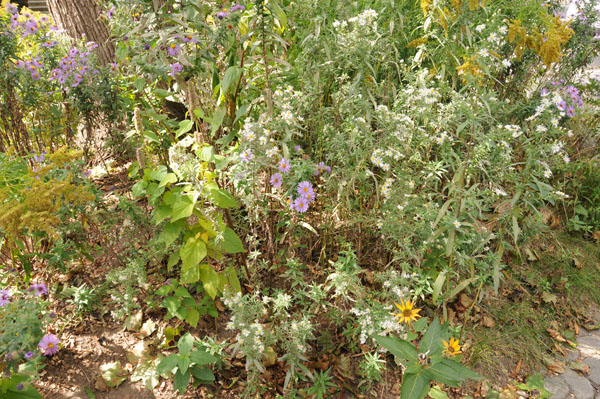
Does this qualify as a North American garden?
The ubiquitous local garden of the north east – a field of asters.
The ubiquitous local garden of the north east – a field of asters.
Roadside Meadow
We’ve all heard of roadside zoos which are not accredited and are not to be encouraged, but roadside gardens? It’s just another way to describe a garden that is living on the edge – a boulevard garden. You can’t get any closer to the edge than by living close to the sidewalk and road.
Highways have carved up much of southern Ontario leaving small pockets of forests. I would like to have had a small forest on my property, but since I’m dealing with a small plot, it’s not suited and it wouldn’t be practical to install one for the front yard. But, there are vast areas of roadside habitat between those forests which could be adapted to the small plot, e.g., a slice of meadow.
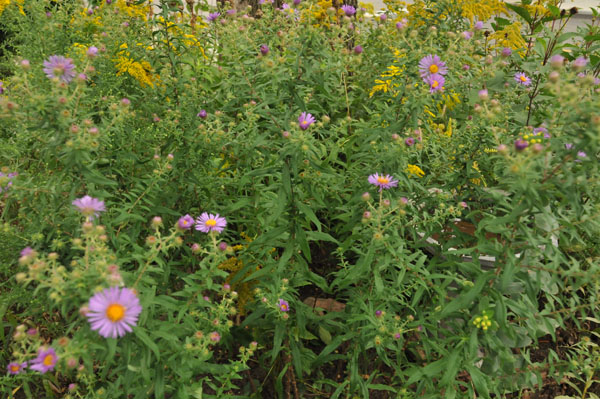
Well, sometimes it doesn’t work out quite as expected. The white asters are not in bloom, yet.
I first envisioned my front garden as a roadside meadow that I’ve long admired: a mix of Canada goldenrod, New England aster and white-flowered asters at its blooming best in late summer/early fall. Great! All I have to do was to borrow that aesthetic and transform the scene from a dream into reality by recreating the perfect roadside garden. After all, my front garden has all the characteristics of a roadside strip – dry, desolate and unforgiving, except that it would have a guiding hand – me.
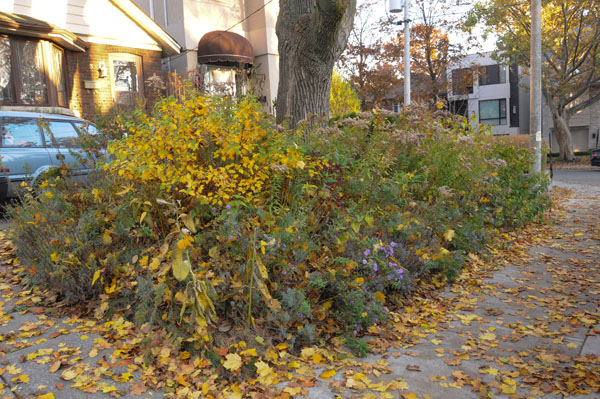
But the fall display can make up for some inadequacies until your dream is fulfilled.
We’ve all seen roadsides which are the purview of the local municipality. But mine would not be mowed or sprayed, intentionally. However, I would have to control the plant mix by plucking here and there and adding as I go. I’ve found the most trying issue is getting the mix right for the location.
The Transformation
The last thing I wanted was my garden to look like roadkill. Oddly enough, that was sort of how it started out when I bought the property ten years ago. I inherited an old, exotic Norway Maple. Some non-native flowers resided on the slope, while the flat portion was lawn. When I decided to finally tackle the garden the next summer, I planned on doing the conversion in two parts, starting with the slope which was a mish-mash of exotic plants and overgrown grasses. I ended up excavating all kinds of hardware – rocks, house and interlocking bricks, and concrete – some with chunks of asphalt! Indeed, there was a blurred line between road and garden when a previous owner decided to shore up the slope with whatever was at hand.
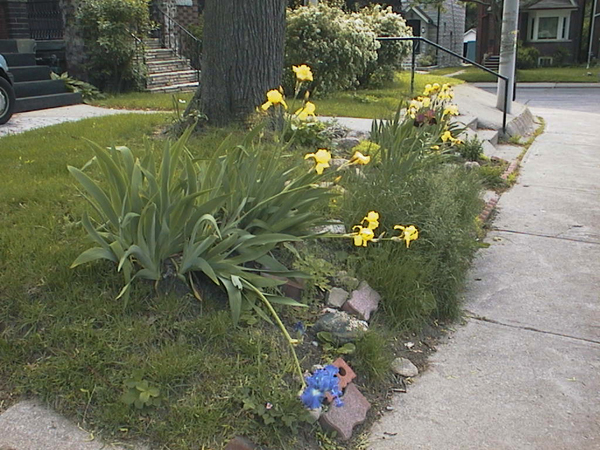
Before: All manner of debris, including aggregate roadkill had been incorporated into stabilizing the slope of the front garden (June 2004).
I salvaged any good rocks and replaced all the junky, hard stuff with large, natural rocks and branches. I couldn’t add too much or anything too big as each piece would take away from planting space and compromise the Norway maple roots. In fact, these elements weren’t doing much to hold the slope since the shallow, extensive Norway maple roots were keeping everything in place. But, the additional elements rising from the earth would add a third dimension and interest at the ground level when plants start to grow up and around.
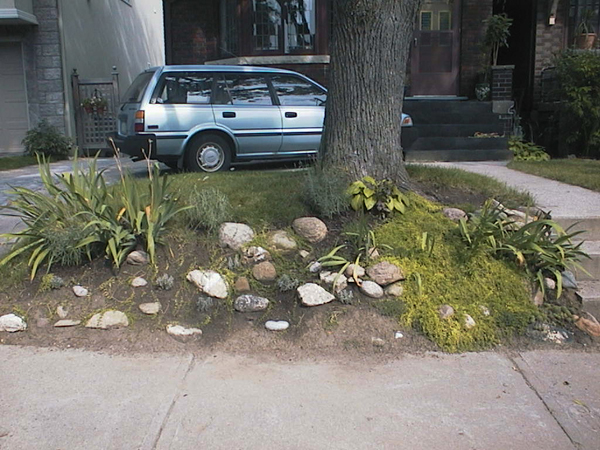
After: Most of the extraneous hardscape, weeds, including grasses were removed. Irises and Asian lilies remained for the moment. Exotic lavender was planted. The planted sedums, temporary ground cover, had started to spread (September 2004).
Part 2 was about to begin: the de-lawning process. To have a successful meadow, you have to smother, spray or strip. Spraying was out of the question. For my small site, since I had lawn and hence fewer weeds, there was only one method permissable – to strip.
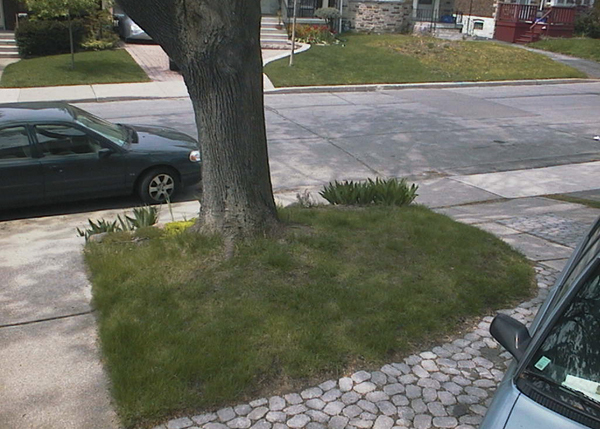
Starting with a clean slate: patch of lawn. This grinned the gardener, was the first thing to go! (May 2005)
So, I stripped…the lawn. I dumped about 20 big buckets of sand mixed with loam. Much to my chagrin, when I was ready to plant about a month later, those Norway maple roots were right at the surface! Nothing can stop a Norway maple! The old adage about not adding too much to the existing soil layer around a tree did not apply here! Bring it on! The Norway maple revelled in its new playing field.
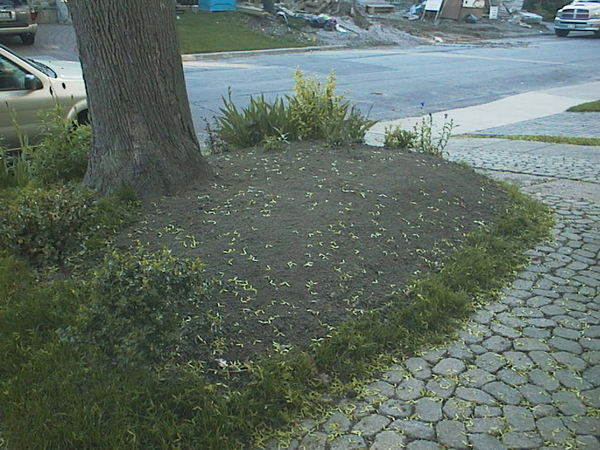
Lawn be gone! Hello sandy, meadow soil! And Norway maple roots?! Look at all those maple keys.
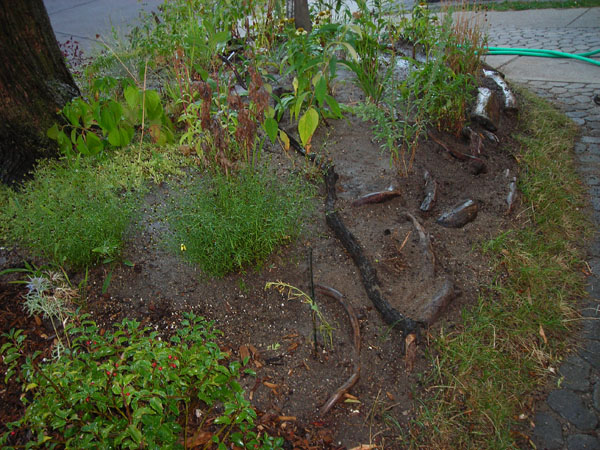
The infill project.
A rim of lawn was kept to hold the soil until new plantings could spread and stabilize the area. Because this was more shaded, it took a long time…
A few elements were added for interest, but hopefully not enough to interest carpenter ants which were living in the Norway maple.
Meanwhile…the front slope was shaping up.
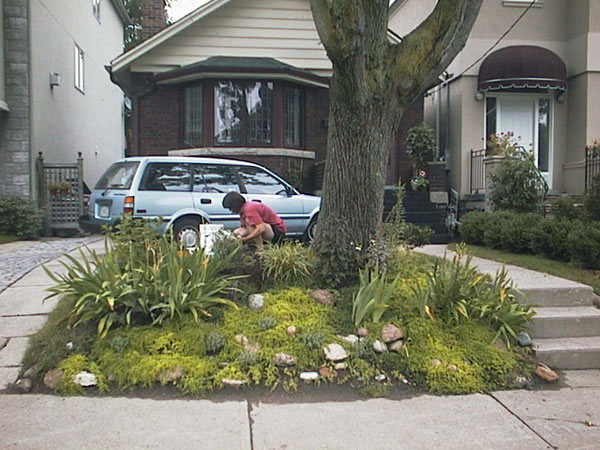
Sedums and hens & chicks spread on the slope. Exotic irises were not removed, yet. Cultivars of ninebark (Physocarpus opulifolius) were installed. Work started on infilling plants in the lawn area (August 2005).
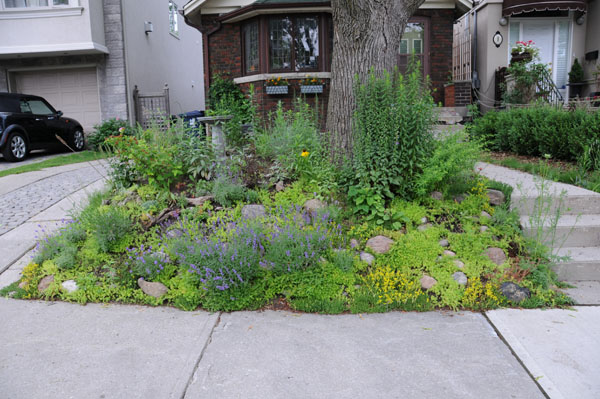
Finally, in 2008, the irises were gone! The original goldenrod at the base of the tree and NE aster started to spread. A relatively short aster, large-leaved aster, was planted at the base of the goldenrod and the basal leaves provided good ground cover.
As we all know, living systems are not static; they change and they may evolve. Meadows eventually evolve into forests. So, while it is a natural process, my front garden won’t be allowed to undergo succession. The seedlings from my neighbour’s chokecherry cultivar have tried to establish but were asked to leave, as were the seedlings courtesy of the resident Norway maple.
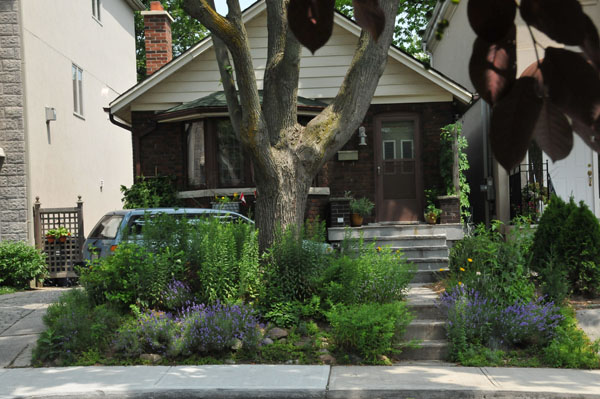
Spring, 2010. Front filling in with lavender in bloom. The sedums started to be bullied out and have for the most part, disappeared with the shading, thanks to the asters. Note the view through the sneaky chokecherry cultivar eyeing my garden to expand its horizons. (Every year, Robins gorge on the fruit and drop the seed into my front garden).
Some of the Players don’t play “nice”
I mentioned in my last post about aggressive plants, and in particular, a garden thug and ultimate bully – false sunflower (Heliopsis helanthiodes). I have had to keep a close eye on its progeny so it doesn’t overwhelm the other asters, some of which are nearly as aggressive – my trilogy of asters, i.e., goldenrod, New England aster and panicled aster. But these three together seem equally matched.
Goldenrod as a Symbol
I took goldenrod as the spokesplant/figurehead for The Local Scoop enterprise – e-newsletter for NANPS, TLS website. The reasoning? With more than 100 species, it was ubiquitous over much of continental North America. I chose C. goldenrod because it was a very common species, well suited to disturbed sites which really describes southern Ontario where I live.
Solidago comes from the Latin word ‘solido’ meaning to strengthen; to make solid and ‘ago’, meaning to make. While the name refers to the medicinal characteristics the flower possesses for human consumption, it’s just the dose of medicine our native ecosystems need. Certainly, the bees go either bee-zerk or buzz-erk over it!
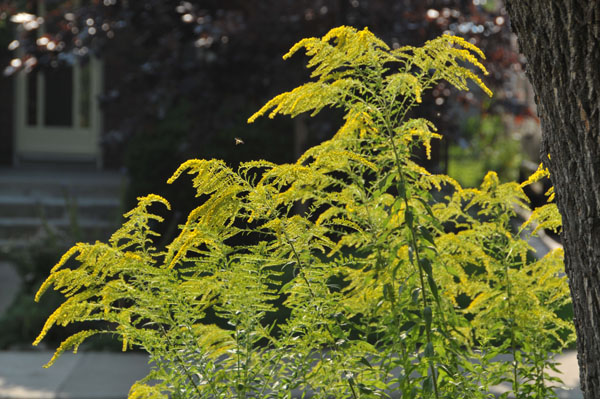
There’s gold in them thar fields!
Goldenrod as a symbol of prosperity in the ecological sense.
Goldenrod as a symbol of prosperity in the ecological sense.
I have a Complex…I think
Yes, I have a complex or at least part of one; that is a goldenrod complex. I have Canada goldenrod (Solidago canadensis) and probably tall goldenrod (S. altissima), if not, a hybrid between the two or perhaps another one thrown in the mix. Canada-goldenrod complex consists of at least six subspecies and varieties. This is all very confusing.
Wind-borne pollen? Not on your life! This bumble bee is helping to spread goldenrod love.
To get a handle on the goldenrods, I have signed up for an intensive two day course on asters and goldenrod at the Royal Botanical Gardens for early September. Hopefully, I can clear up some taxonomic questions from an expert who has about 50 years experience. Dr. James Pringle was co-author of a newly described species from northern Michigan, Solidago vossii.
And who knows? More genetic testing could reveal more species than the 100 or so that are currently described for North America. The more the merrier, if not to keep the taxonomists busy! I’m sure I’ll have enough fodder to write a few posts just on Solidago spp., never mind the other asters.
Meet The Main Meadow Residents (besides goldenrod)
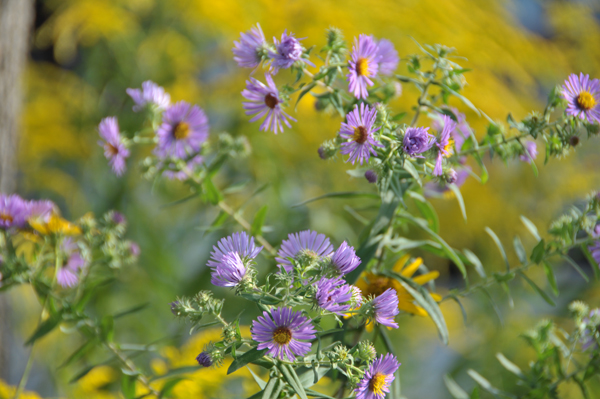
New England aster (Symphyotrichum novae-angliae).
New England Aster: more widespread across North America than sky blue aster; stiffer stemmed than most goldenrods except stiff goldenrod (which is a shorter species of goldenrod); fairly hairy stems; leaves clasp stem; flower heads close up for the night; open branching pattern helps to maintain its upright appearance without peer support.
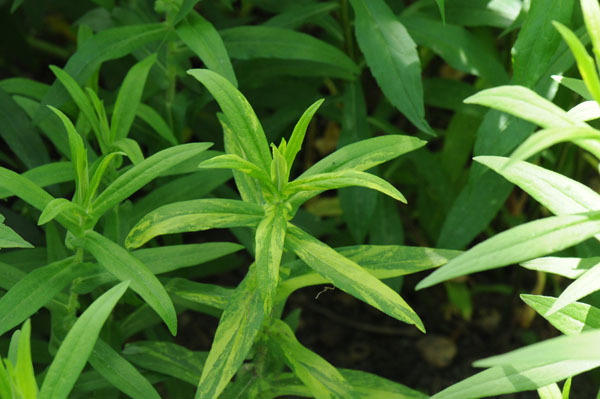
A variegated New England aster (Symphyotrichum novae-angliae).
A naturally, variegated New England aster spontanteously appeared amongst the regulars.
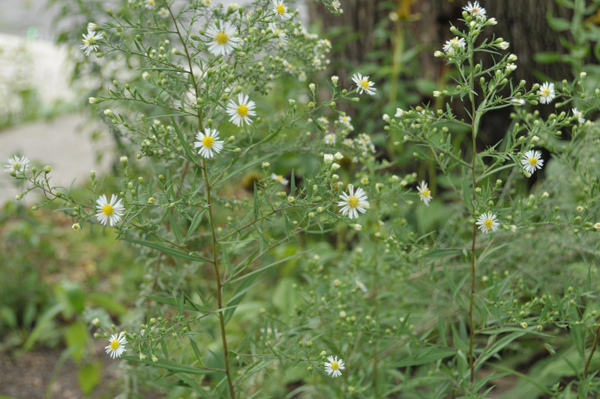
Panicled Aster (Symphyotrichum lanceolatum).
Panicled Aster (Symphyotrichum lanceolatum) is an open spreading form of aster with very slim, reddish stems which stay erect without the support of others.
…and a few minor ones
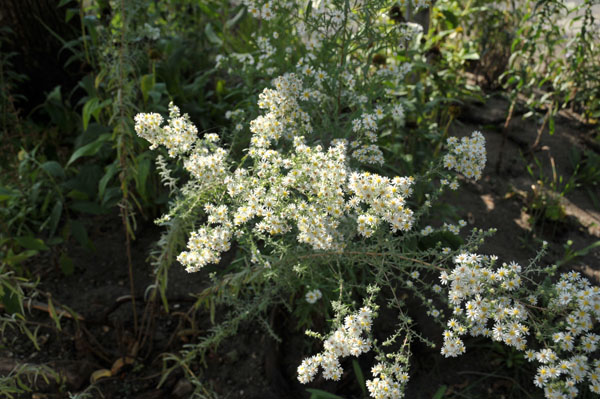
Heath aster (Symphyotrichum ericoides).
Heath aster (Symphyotrichum ericoides) with its tiny, white flowers compacted seems to bloom later than either New England aster or goldenrod. Its very fine stems can’t hold up the flowers without the support of other asters.
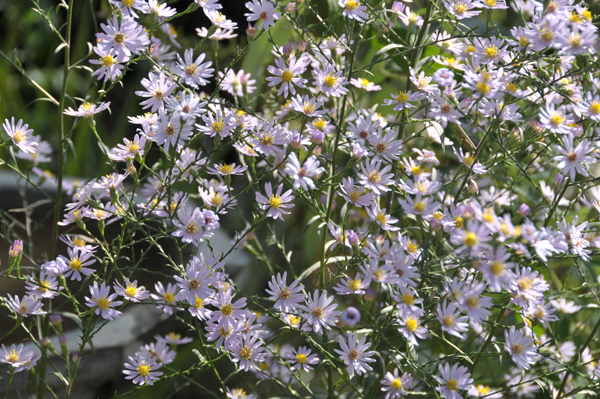
Sky Blue Aster (Symphyotrichum oolentangiense).
Sky Blue Aster (Symphyotrichum oolentangiense) with its mauve flowers is another open spreading form of aster found in the eastern half of the US & Canada.
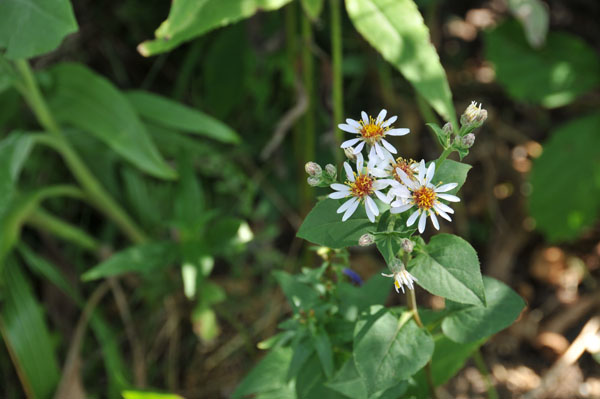
Large-leaved Aster (Eurybia macrophylla).
Large-leaved Aster (Eurybia macrophylla) has corymboid or flat-topped inflorescences. A similar species, heart-leaved aster (Symphyotrichum cordifolium) has flowers in a rounded panicle. The basal leaves are similar for both.
Certainly, there is room for improvement. The Canada goldenrod will be marched up the slope to the top or they will be cut early in the season to force them to branch out and lose a little stature. I have to curb their enthusiasm, as they have a tendency to flop over the sidewalk with their heavy heads after a rain fall. Perhaps I’ll replace them with increased numbers of stiff goldenrod, as they are sturdier and shorter. I’ll probably add more large-leaved aster, too. Though, as with all large-leaved asters, it tends to look droopy in drought conditions. But being drought tolerant, it perks back up with the next rainfall.
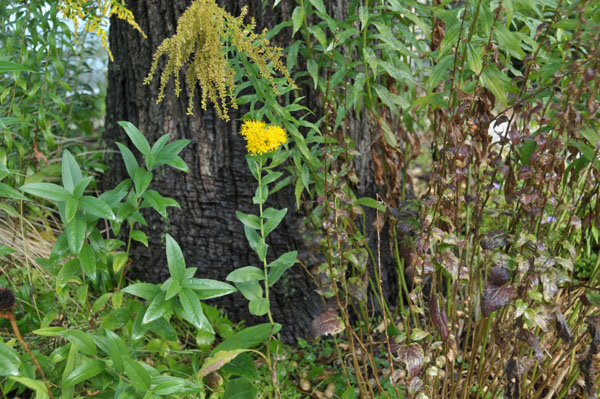
Stiff goldenrod (Solidago rigida). Goldenrod all the way but with a compact, sturdy stem and an upright dispostion.
I could never be accused of adding to the blandification of the urban residential landscape. And surely my front yard devoid of lawn and packed with lots of native plants is sending out a strong pro-environmental signal. The only problem is…the ignorant don’t recognize it as such. Some of them think they are weeds. But, there is hope when you see people admiring the bumble bee collection or fall display.
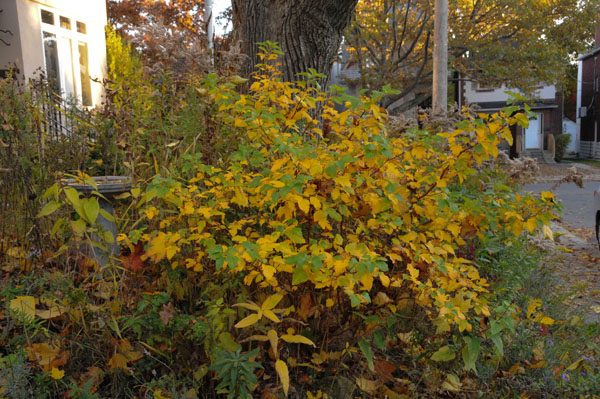
The fall regalia.
But still it kind of irks me when I see the typical garden writer in late summer go on about the garden winding down, when in fact, the native garden is ramping up and getting ready for the spectacular fall flush of flowering and then the second act of fall regalia replete with yellows, oranges and reds.
Which brings us to…
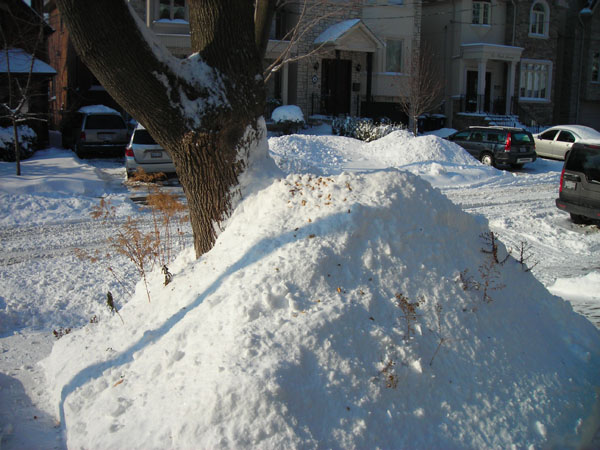
The garden chillin’ out. I just wish the detractors would do the same. Snow is the great equalizer. It covers up a lot… except a few sprigs of goldenrod on the left and New England aster on the right. Native plants have staying power!
Originally published August 31, 2013 on Native Plants and Wildlife Gardens
Comments

Ellen Honeycutt says
September 1, 2013 at 8:35 am
September 1, 2013 at 8:35 am
An early white blooming flower, if it is native to your area, would be some the white Eupatoriums (what people call boneset, there are several species). In my area they bloom well ahead of the white asters and concurrent with the earlier goldenrods like S. odora.
A nice project, it was good to see the transition and hear about the process/steps you went through.
Ellen Honeycutt recently posted..By the Gurgling Stream

Mary Kay Scott says
September 1, 2013 at 11:45 am
September 1, 2013 at 11:45 am
Thank you for telling this story – it gives me hope that my small space will one day be gorgeous like yours :)
Mary Kay Scott recently posted..Map Your Habitat

Gail says
September 1, 2013 at 12:27 pm
September 1, 2013 at 12:27 pm
You have a lovely North American garden! Not sure if it’s native where you live but Verbesina virginica is a great white flower that’s blooming in my Middle Tennessee garden right now~it’s chock full of wildlife value, too. gail
Gail recently posted..Wildflower Wednesday: Hardy Blue Mist Flower

Cynthia, aka Gaia gardener says
September 1, 2013 at 8:20 pm
September 1, 2013 at 8:20 pm
I love reading about your process – and seeing it illustrated in photos as well. Just wonderful.
Like you, I’m fascinated with goldenrods and asters. They are such iconic North American plants! If you can find it, you might check out elm-leafed goldenrod (Solidao ulmifolia). It grows well in shade and maxes out about 30″ high, at least around here. It isn’t as aggressive as Canada goldenrod and has an open, airy feel to it; it also blooms a bit earlier than Canada goldenrod, so it extends the bloom season a bit. I checked on the USDA plant profiles, and it should be native up in your neck of the woods, although that doesn’t necessarily mean that you’ll be able to find it, unfortunately.
Cynthia, aka Gaia gardener recently posted..A Hanging Thief Enjoys Dinner

cynthia says
September 2, 2013 at 7:17 am
September 2, 2013 at 7:17 am
I love your native plant garden. You have done an amazing job getting anything to grow under a Norway Maple. Have you considered planting Phlox subulata as a ground cover? It could do a great job of holding the soil on the sloped edges of your garden and bring in some spring color to what is now mostly a fall blooming garden. It is also a pretty sturdy plant and won’t mind if it is stepped on occasionally which may happen so close to the walkways. Here, in New Jersey, phlox subulata has the added advantage of being almost evergreen. Another great groundcover is the native Sedum ternatum which takes a lot of shade and also blooms (white) in the spring.

James Hitz says
September 2, 2013 at 10:04 am
September 2, 2013 at 10:04 am
Perfect front yard. I love Laura Ogden’s front yard view, how true. If local authorities deny this look, it is time to step up and join the board.

Leslie says
September 2, 2013 at 10:55 am
September 2, 2013 at 10:55 am
Why would you keep an invasive & not replace it with a native?
Native Plants Weeds - Norway Maple
Native Plants Weeds - Norway Maple

Suzanne Dingwell says
September 2, 2013 at 10:04 am
September 2, 2013 at 10:04 am
Janet, what a wonderful job you have done in your persistent effort under that unforgiving Norway maple! Your North American garden is not only beautiful, but a fantastic, living, growing advertisement for all that we claim about native plants. Thanks for all the details you have included in this post.
Trackbacks
Best Nectar Plants for Monarchs and Other Butterflies says:
September 11, 2013 at 3:29 pm
September 11, 2013 at 3:29 pm
[…] and of course, goldenrod […]
Roadsides for Wildlife says:
September 27, 2013 at 3:57 pm
September 27, 2013 at 3:57 pm
[…] My Roadside Garden […]
Fall Flowers says:
October 7, 2013 at 10:10 am
October 7, 2013 at 10:10 am
[…] "wild" areas of my yard have dozens of the white asters that pop up in large numbers in disturbed places. It’s been weeks since I’ve seen […]
Native Plant Species Articles Index
The Following articles were originally published on the Native Plants and Wildlife Gardens website.