Norway maple – I’m stuck with you
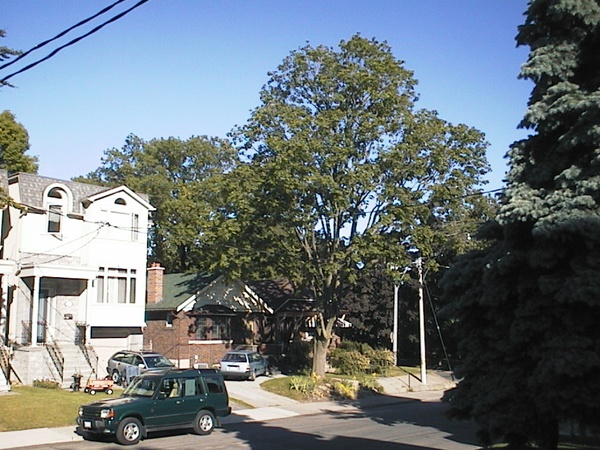
norway maple
I’m conflicted. Everything about the Norway maple (Acer platanoides) points to it being a blight on
the landscape. It’s invasive; taking over our ravines and crowding out native species. It is not a
multi-purpose tree. True – it gives shade, produces oxygen, filters the air, and mitigates
stormwater. But, it doesn’t host any insect parties. From what I’ve seen, it’s only good for aphids
and tar spot fungus (Rhytisma acerinum).
Making a mint
Why, in Canada, Norway maple has supposedly even infiltrated one of our government institutions –
The Royal Canadian Mint. According to some, it’s in circulation as legal tender on our new polymer
bills! This caused a big,
botanical flap
last year when the $20 bill was introduced and several botanists pointed out that what was supposed
to be a sugar maple leaf looked more like a Norway maple. The Mint pleaded artistic license, or in
this case, botanical license, saying that “the leaf is a stylized blend of different Canadian maple
species”. Leaves are variable in nature, but I don’t think they look quite like either Norway or
sugar maple. With so many teeth, maybe it has a touch of red maple and ? View a selection of leaves (under Genus Acer).

Partial view of $20 Canadian bill showing maple leaves.
Apparently, no one carries around a wad of $50 and $100 bills which were rolled out much earlier
with the same rendition of the leaf and did not cause a flutter. I guess if you can flash that kind
of cash, you won’t notice the vegetation on our only green bill and you are not employed as a
botanist.
Since Norway maple is more ubiquitous than the eastern species, sugar maple, making it more
representative of Canada as a whole, should we be surprised?
Maybe I shouldn’t bring it up, but those leaves on the right side look like Norway maple leaves. And
the corn poppies (Papaver rhoeas) on the reverse side of the $20 bill are non-native and
considered invasive in Alberta.
More evidence that the Canadian government has been invaded: the Mint started phasing out the penny.
Hint: it had a sugar maple depicted on it.
I would love to get rid of the Norway maple, both on the bills and in the environment. But I’m stuck
with the currency and with a behemoth…
It all begins at home
When I first lay eyes on the tree, it was part of a package.
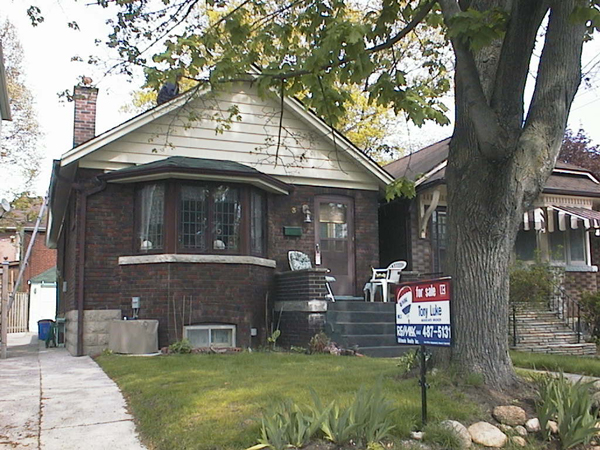
House with norway maple.
I wanted the bungalow and a chance to have a garden, yet this tree came with it. A mature tree is a
selling feature, but for someone who recognizes it as a Norway maple and is knowledgeable about its
faults…well it does take a little bloom off the rose.
How to reconcile the disappointment of not having a native tree, particularly the only large tree on
your property? Learn to live with what you can’t change and make the best of it, warts and all! Many
people enter into a serious relationship with the expectation that they can make drastic changes to
their loved one, only to find the immovable boulder. Similarly, a large tree is a major structural
element of the garden that can’t be changed and is not an accessory that can be disposed of easily
when it doesn’t fit into the garden scheme or someone has grown tired or bored of its existence.
Reality hits in the form of a bylaw which soon puts a stop to thoughts of removing large trees –
usually. In Toronto,
Chapter 813, Trees, protects all city trees and those trees on private property with a diameter at breast height
(dbh) of 30 cm (12”) or greater. If it is a city tree, owned by the city and fairly healthy, no
matter the size, there is no way they will remove it on a whim.
Indeed, sometimes the city goes to the extreme to keep a tree even though it is damaging a
foundation. Other times, it gives the all clear to clear cut for development. In many instances,
it’s all political with municipal councillors weighing in. In reality, trees are not as valued as
they should be. If they were, development would be forced to accommodate existing vegetation. Now
there’s a progressive concept!
When a tree falls…or a branch
As a rule of green thumb, I have suggested planting a tree at least a minimum of 3 to 4 metres (over
10’) from a house to give the tree roots room to grow. Large species, like oak, need more room.
LEAF, (Local Enhancement & Appreciation of Forests) a not-for-profit
organization has a guideline for requirements of backyard planting which has merit for front yards
as well.
Besides large tree roots, the other hazard near structures is falling tree branches. Hazards can’t
be eliminated when you live in confined areas, like small city plots which don’t have ideal
conditions for city trees, i.e., which may have been planted closer to the house and now those
branches overhang the house rather than just cast a shadow.
In other cases, branches falling can be totally avoided. NPWG Team Leader,
Carole Sevilla Brown documented her fight with a neighbour that could
have been titled: “How not to take Norway maple down safely” or “Extreme Arborism not for the faint
of heart or mind”.
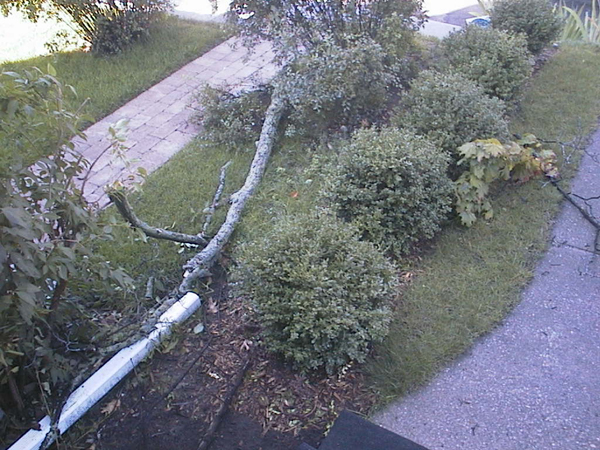
Branch debris and dented downspout disconnection.
My Norway maple usually drops tons of keys in the spring and aphid “pee” all over the car parked on
the driveway. It had dropped a couple of small branches during wind storms. One larger branch broke
and dented my neighbour’s downspout disconnection and loosened the hydro lines between our houses.
The most significant branch to date fell after high winds on Friday, September 23, 2010. A neighbour
phoned to inform me that a branch had dropped on my car. I called the city to report the incident
and raced home from work to find a large branch adorning my car like a rack of antlers.
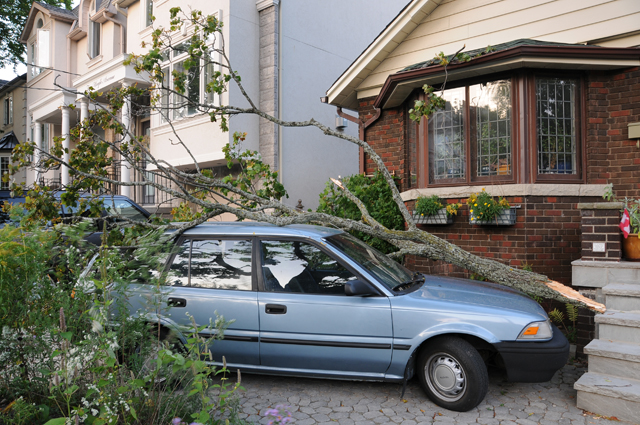
Nice rack! Wood panelling anyone?
This was not a good situation. We had a NANPS field trip to some tallgrass prairies the next
morning. We couldn’t move the branch, not because of the weight, but because we wanted the incident
documented by the city when they showed up to remove it. So, while we waited, we took pictures. The
wind had carried the branch far enough to hit the car, otherwise, it would have dropped straight
down onto my front path and likely miss the car.
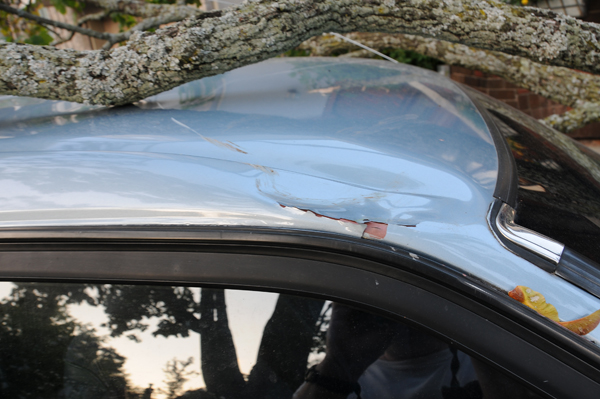
Contact point – roof dent. Note the sneaky Norway maple keys tucked into the roof channel (seed
dispersal urban style).
The frame at the corner of the car roof took the main brunt. There were a few scrapes and bruises to
the car as the branch rolled across the hood. Fortunately, the windshield was intact.
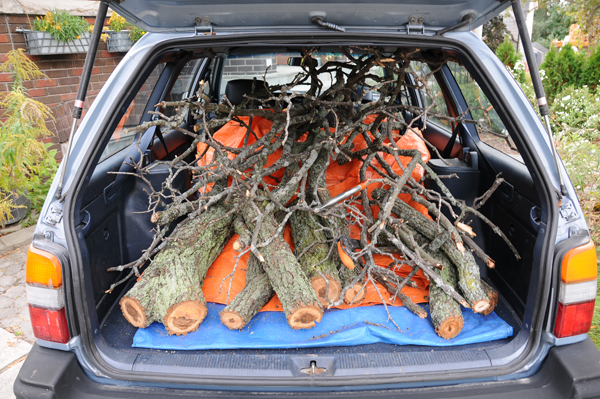
The loot in the boot, custom cut. Off to ZooWoods restoration site.
Finally, a city crew showed up around 10:30 at night wielding the cutest little chainsaw I’ve ever
seen. I was able to convince them that I needed to keep the woody debris for a restoration project,
so they obliged and cut it into perfect lengths to fit the car.
Fight with the City
Of course, then we had to deal with the City for damages. Since the city owned the tree, they were
libel for property damages. At the time, it was typical for the insurance firm contracted by the
City to push back and deny claims. Of course with those kinds of odds, we were initially denied.
They tried to tie the “book value” of our old, yet well-maintained vehicle to the claim. I firmly
told them that just as my house is property, my car sitting on the driveway is property and besides,
they were not my auto insurance company.
We caught a break. At the same time, the Toronto Ombudsman was investigating the issue of the high
rate of denials, to the tune of about 94%. So, between the increased scrutiny of the insurance
claims issue and our persistence to the point of being ready to take the City to small claims court,
they settled for the exact amount it cost to fix the car.
It’s an old cliché, but you can fight City Hall. More importantly, sometimes you can win.
The case for urban trees
In 2007, Toronto put together a plan to double the tree canopy from about 20% to 40% by 2050. In the
report, Every Tree Counts from the City of Toronto, Parks, Forestry
and Recreation Department they identified the most effective strategy for increasing average tree
size and tree canopy is to preserve and manage existing trees in the City. So throw out the idea of
replacing mature trees with a bunch of “saplings”.
Some of their findings:
We have just over 10 million trees in Toronto; 40% of which are on city property with only 6% as street trees.
The average tree diameter in Toronto is 16.3 cm (6.4”). Only 14% of Toronto’s trees are greater than 30.6 cm (12”) in diameter.
The size of a tree and the amount of healthy leaf area equates directly to the benefits provided to the community, e.g., a 75 cm tree in Toronto intercepts ten times more air pollution, can store up to 90 times more carbon and contributes up to 100 times more leaf area to the City’s tree canopy than a 15 cm tree.
The trees in Toronto store 1.1 million metric tonnes of carbon annually or the equivalent of annual carbon emissions from 733,000 automobiles, as well as reduce energy use from heating and cooling of residential buildings by 41,200 MWH ($9.7 million/year), improve air quality by intercepting 1430 metric tonnes of air pollutants ($16.1 million per year) and mitigate storm water runoff.
Toronto’s urban forest is estimated to be worth approximately $7 billion and provides over $60 million per year in ecological services.
The benefits derived from the urban forest significantly exceed the annual cost of management.
How does my tree fit into the scheme?
Being larger, it is in the minority. My Norway maple is about 80 years old with a dbh of about 68
inches (173 cm), but with a sparse canopy. Unfortunately, it has dropped small and large branches.
However, it provides shade on the front of the house and still allows me to grow a variable, native
garden beneath, which wouldn’t happen with a healthy Norway maple. Even with a reduced canopy, the
maple is still of value to wildlife and the community. I admit it begrudgingly.
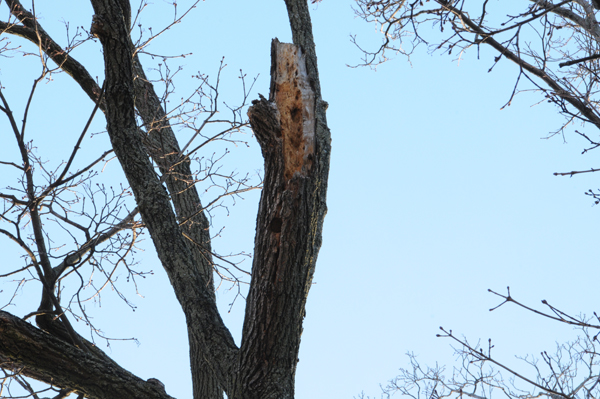
Origin of broken branch. Branch weakened by carpenter ant forays.
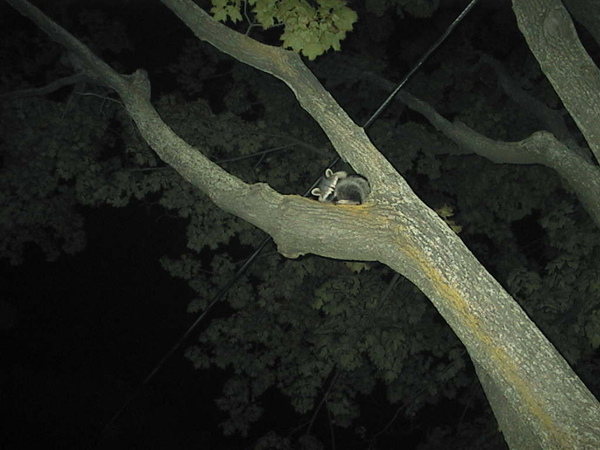
Sleep over, raccoon style. Norway maple provides habitat.
Replacement Trees
Street trees do die and for many of them, it’s a premature death given the harshness of the urban
environment and their location of
living on the edge
(average of 8 years for newly planted trees on the boulevard.). At the rate we are losing trees,
exasperated by paving over of green space, is our goal of 30-40% canopy cover achievable? Perhaps
so, if we can convince private property owners to plant trees, since they represent the guardians of
60% of the canopy cover. Our main proponent is LEAF.
Toronto has a program for replacement trees abutting private property. The
list of trees include those found in southern Ontario, North America
(Carolinian forest types) and outside the linntinent. Norway maple was removed from the list quite
awhile ago. Ashes, both native and European were removed recently due to the decimating effects of
Emerald Ash Borer. The list of native species is very short: maples (sugar, black, red, and silver),
oaks (black, red, bur, chinquapin, and swamp white), hackberry and ironwood. Ten species are native
to North America and thirteen species are native to Europe or Asia or are hybrids, including a
silver-red maple hybrid – Freeman maple (Acer x freemanii).
The trees are not chosen for the wildlife value, but only for their ability to withstand the urban
environment, particularly on the boulevard. Hopefully, residents will choose native trees over
exotics to boost wildlife value, particularly with the pollinators.
Yes, size matters to the City: the bigger, the better. A large-leafed tree with a big canopy is to
be promoted. Note: smaller canopy wimps like serviceberry need not apply. Fleshy, fruit-bearing
trees can be problematic, so they are skipped over. There was a concern about crabapple trees and
wasps plaguing the boulevard…yet it is fine to have highly invasive mulberry trees (Morus alba)
dropping purple rain all over the sidewalks?
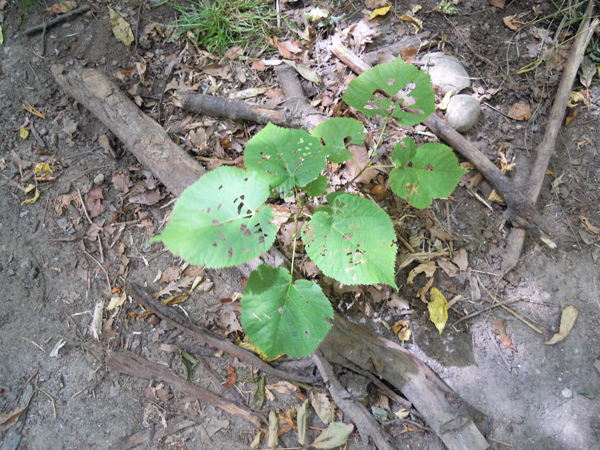
My dream tree… in about 40 years. Note the amount of damage due to herbivory.
Dream Tree – Every one has at least one
I went ahead and bought the whole package: the house with Norway maple in tow. But I was always
wishing the exotic maple was a native sugar maple or a basswood or an oak; a species with
high wildlife value. And then I lived through the fall of acorn rain
when a neighbour’s backyard red oak had a mast year and we were snowed in with a blanket of blooms;
a copious flower crop and then acorns dropped in the form of little backyard bombs. Another line was
added to the list of reasons to plant trees a good distance from a house’s foundation, besides
giving the tree breathing space and to allay any worries of Jack & the Beanstalk imagery. Maybe it
was all well and good that I didn’t have an oak in the front yard. But a basswood would have been
nice.
According to Douglas Tallamy, basswood, as a single species, is host
for over 150 species of caterpillars in North America. And using the Tallamy table in his book,
Bringing Nature Home (pg. 147) on a per-species basis, this makes basswood the most productive of
all the trees. It would be a beacon for neighbourhood butterflies and moths; the only one on the
street, as far as I know. Heaven knows, I have to keep up with the neighbours who have an American
beech tree, a sole species in the genus Fagus and host of over 126 lepidopterans.
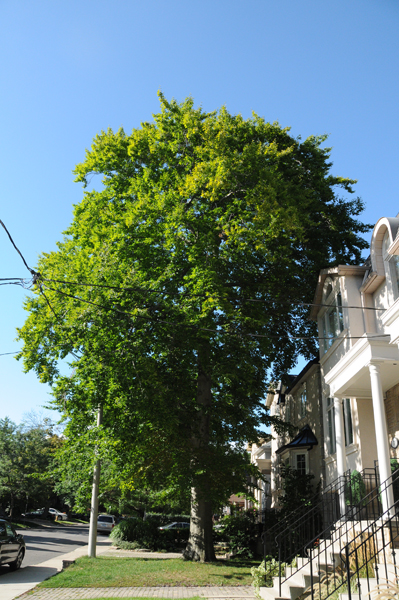
Neighbouring tree. A beautiful specimen of American beech (Fagus grandifolia) – the best
tree and envy of the neighbourhood, or at least of me.
My choice of basswood is not on the grand list for front yard planting, probably because it is salt
intolerant. Instead Redmond linden (Tilia americana ‘Redmond’) is offered. Interesting that
they don’t include the more commonly planted exotic ones we normally see: littleleaf linden (T. cordata) or the common linden (Tilia ×europaea), a natural hybrid of the small-leafed lime (T. cordata) and the large-leafed lime (T. platyphyllos) from the Netherlands. (More detail on
Tilia).
However, if I go with the basswood, I may not escape flower or seed drop and especially
aphid rain. But, it sure would make up for it in attracting lots of
pollinators.
I would miss this view if the Norway maple was gone.
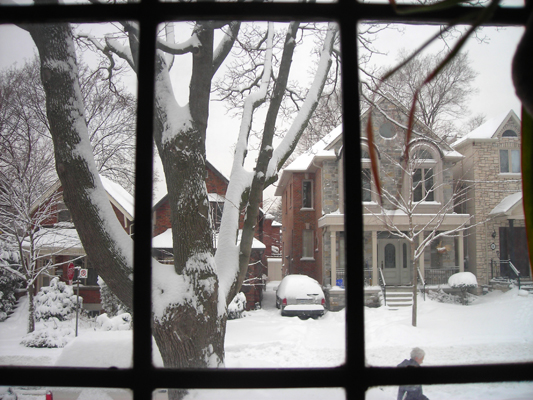
A room with a view…to a tree.
Norway maple – love it or leave it?
I could move or just live with it. But for now, I’ll live with it while I pick out its seedlings in
the spring and watch out for gusting high winds.
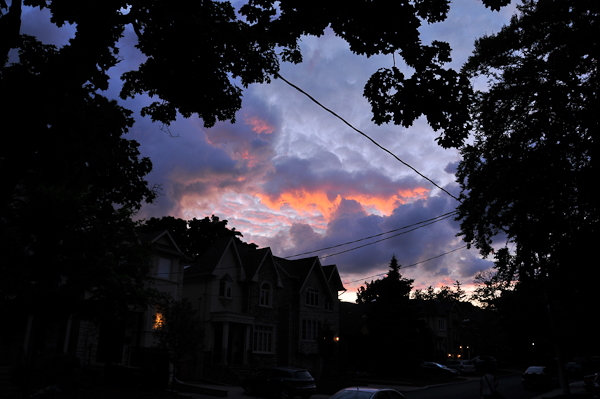
Low hanging Norway maple leaves and the nearby beech canopy bask in the glow of the sunset.
Originally published June 26, 2013 on Native Plants and Wildlife Gardens
(Article is no longer online.)
Comments

Jodi DeLong says
June 26, 2013 at 12:05 pm
June 26, 2013 at 12:05 pm
I feel your pain, and your conundrums, Janet. Someone had planted half a dozen Norway maples at my
previous home, and while they weren’t big, I couldn’t at that time find it in my heart to cut them
down. Last year I had decided to remove two of them and put in other, native maples or a basswood or
two, then my partner died and I no longer live there. Problem solved–for me. Where I am now, there
are native red and sugar maples, among other trees. I work to educate people NOT to plant Norway
maples, even the less invasive ones (I am dubious about their being less-invasive, though). It’s a
struggle sometimes. Thank you for taking the time to create this thoughtful, well-written post. May
we all learn from it.
Reply

Janet Harrison says
June 27, 2013 at 11:37 am
June 27, 2013 at 11:37 am
Thank you, Jodi.
I’m glad that you were able to move on to continue planting native species and educating others.
Indeed, it is a struggle with so much ignorance out there. And we are constantly learning.
Education is paramount. The key is to recognize the species you have on a property and remove
the invasive ones, if you can. At least you dealt with the situation before it became
unmanageable. I’ve become quite clinical with removal of invasives. While I admire their
tenacity and respect them as living beings, I always keep in mind that they were not meant to be
here. Even though it isn’t their “fault” for being here – they have to go. My allegiance will
always be with the native species, wherever I am.
Keep up the good work!
Cheers,
Janet
Janet

kelvin boyle says
June 26, 2013 at 12:22 pm
June 26, 2013 at 12:22 pm
An interesting article and certainly an educational one for me. Many thanks.
Reply
Janet Harrison says
June 27, 2013 at 11:42 am
June 27, 2013 at 11:42 am
Thank you, Kelvin.
I think I have learned more in the past couple of years than in the previous twenty. There is so
much more to learn, that it is overwhelming. But if I can distill some of the information out
there and pass it along, I’ve done my duty.
Cheers,
Janet
Janet
Jason says
June 26, 2013 at 12:26 pm
June 26, 2013 at 12:26 pm
I enjoyed this post. The city here used to plant lots of Norway maples. Many died early because the
contractor planted them too deep. When one side in front of my house I was given a choice of
replacements. I went with hackberry, which has been doing OK. Can’t believe your city actually
plants mulberry. Aren’t there enough without our help?

Bird says
June 26, 2013 at 12:39 pm
June 26, 2013 at 12:39 pm
I started with 6 old norway mapes in my zone 6 yard. Now I’m down to 3. Several were in such bad
condition, more than half-dead and dropping huge limbs every winter, that we had to have them cut
down for safety reasons, and there wasn’t too much left to take down anyway. I was glad to see them
go. As the article mentioned, they always have black spot, and the winter moth caterpillars devour
the leaves.

Carole Sevilla Brown says
June 26, 2013 at 12:48 pm
June 26, 2013 at 12:48 pm
It is a dilemma, isn’t it? As much as I have railed against those Norway Maples in my neighbor’s
yard, it still sad to see them destroyed all at once in the way that they were. I loved watching all
of the woodpeckers who nested in those trees: Downy, Hairy, Red-bellied, and also Flickers and
Sapsuckers. We’ve even had a family of Pileateds stop by to forage for insects under the bark. Now
they are all gone. So is the nesting Chickadee family who left after this guy dropped a very large
trunk on their house. Gone also is the Baltimore Oriole male who had been spending every day singing
from the branches of the Norway Maples.
What I won’t miss, though, is the danger posed by those trees to my house. Every time we had a
storm, large branches from these trees would break off, sometimes damaging my roof. They are trashy
trees, dropping seeds and other detritus in every season. And nothing grows underneath a closed
canopy of those branches.
Even so, I would not have removed them all at once like just happened here.
Carole Sevilla Brown recently posted..The Demise of the Norway Maples

Hendrica Regez says
June 26, 2013 at 4:12 pm
June 26, 2013 at 4:12 pm
Thanks for a great article!
We did kill our Norway Maple and let me tell you, it made us feel like murderers… On the other hand,
it’s seedlings were sprouting everywhere. We live near the Mississippi and don’t want to contaminate
our natural areas. Planted a sugar maple instead, but it has a lot of growing to do yet.

Deborah Dale says
June 26, 2013 at 11:28 pm
June 26, 2013 at 11:28 pm
As always, an education Janet! Toronto just took out 200 mostly 50-60 year old street trees in a
neighbourhood I frequent (a mix of Norway maple but including several @20 year oldnatives) as part
of a major storm water control project (they needed the space to store contractor equipment). Like
you, I was of two minds…they were Norway maples after all, but they had value as shade and their
thirsty shallow roots contributed greatly to controlling excess precipitation. Disappointingly when
the city redid the curbs, they raised them funneling all the rainfall into the newly reconstructed
sewer system rather than diverting at least some of it into infiltration beds that could have been
placed along the wide boulevards.
My own street just lost all its 1970’s era ash trees to the Emerald Ash borer. Toronto’s suggested
replacement to front my native plant garden? Japanese elm. Finding city rules allowed homeowners to
plant their own trees if they guaranteed ongoing care for 2 years, I opted for an almost locally
native tulip tree, only to be told that an approved contractor with $2million in liability insurance
would be needed. I planted my dream tree anyway (spending $4 (wholesale native tree nursery sale) vs
the city’s claimed cost of $400/tree)…and I’m keeping my fingers crossed that common sense will
prevail when the crews come along to replant the street this fall. As ever, the miscreant gardener
:D
Deborah Dale recently posted..Green Evolution Site Gallery

Donna@Gardens Eye View says
June 30, 2013 at 7:49 pm
June 30, 2013 at 7:49 pm
Janet we used to live in a house surrounded by black walnuts and eventually were used to the idea
that little grew under them and the walnuts raining down on the roof was a sound we got used to…the
squirrels and chipmunks were happy. I am hoping to replace my native ashes with a basswood…we had a
large one at our old house…loved it. I hope you get your wish some day.
Donna@Gardens Eye View recently posted..Simply the Best Herbs-June

loret says
July 4, 2013 at 12:16 pm
July 4, 2013 at 12:16 pm
Nice article. While I don’t have to deal with the Norway maples down here in Florida, I do remember
the one at my home in NY. It was a rather odd tree, only one side would produce any leaves. I
referred to it as my “half-a-tree”.
I did love the leaves of that tree, and had no idea that it was invasive. It stood as a specimen and
it behaved (at least in my yard) or perhaps I just mowed down the seedlings without noticing. I
lived there for over 20 years without sight of another.
loret recently posted..Gator-ette

Sky Fairfax says
September 16, 2014 at 9:38 am
September 16, 2014 at 9:38 am
I too am not a fan of Norway Maples, but while researching a book, I came across this: “Marte Aas –
What do the trees say?” It seems that a Norway Maple was hooked up to a computer in the Botanical
Gardens in Oslo, and the results were interpreted as a sonogram and then words. I read the comments
with laughter and delight, and now feel more charitable to our imported maple.

Ron Mitchell says
December 9, 2014 at 5:13 pm
December 9, 2014 at 5:13 pm
I enjoyed the article very much. I would not have a problem taking a Norway down. They at least make fairly good firewood. There are so many natives better ecologically suited to be grown here. Nothing is perfect but some things have more problems, and the Norway is one of them.
Trackbacks
Dangerous Tree Removal by Goodman & Ross Trucking says:
June 26, 2013 at 1:26 pm
June 26, 2013 at 1:26 pm
[…] see Norway Maple I’m Stuck With You for another perspective on this invasive […]
Tree Massacre in Wildlife Garden by Earl Ross says:
June 26, 2013 at 1:27 pm
June 26, 2013 at 1:27 pm
[…] The Norway Maple sheds large branches from the top, then resprouts along the trunk. Every time the wind blows large branches fall from the top of the tree, making me very nervous about my roof. […]
Norway Maple most hated invasive plants says:
June 26, 2013 at 1:30 pm
June 26, 2013 at 1:30 pm
[…] Norway Maples have severe environmental impacts: […]
My Roadside Garden says:
September 1, 2013 at 10:55 pm
September 1, 2013 at 10:55 pm
[…] was sort of how it started out when I bought the property ten years ago. I inherited an old, exotic Norway Maple . Some non-native flowers resided on the slope, while the flat portion was lawn. When I decided to […]
Winter Wallop says:
January 26, 2014 at 5:09 pm
January 26, 2014 at 5:09 pm
[…] dropped another branch. Every major storm event seems to cause it to shed more branches. Last time, my car parked on the driveway suffered the Norway maple slings. This time, it punched out the rear […]
Footsteps Ecoman says:
March 2, 2015 at 6:29 am
March 2, 2015 at 6:29 am
[…] go so far as to say forgettable. It is an Acer Platinoides (Norway Maple), and if you have one, you know that gardeners love to hate this tree. Helen and Sarah Battersby and others have written about the difficulty of gardening with Norway […]
Native Plant Species Articles Index
The Following articles were originally published on the Native Plants and Wildlife Gardens website.